Mind Mapping is a technique for visually organizing thoughts and ideas, and its usefulness in the classroom is only growing as we transition into a more visual and technological society. I originally encountered the idea of "mind mapping" when I first learned of the work of Tony Buzan, an educational consultant. Having read several articles by and about Buzan and mind mapping, I became intrigued by the concept. Making a mind map begins with a central topic and expands into a web of branching subtopics and ideas. It is an obvious and useful tool for brainstorming ideas, planning projects and events, and managing notes. Recently, I encountered MindMaple - a company committed to developing helpful and accessible mind-mapping software.
Mind mapping is an exciting educational tool because it promotes creativity and innovative thinking in ways other information techniques do not. And, as I've long argued, creativity and innovation is the key to American success. I've also noted the importance of using the brain's natural capacity for making connections to process and make sense of new information. Thus, it's worth talking about what MindMaple does and how mind mapping can be useful in the classroom and how it offers benefits that other information technologies do not.
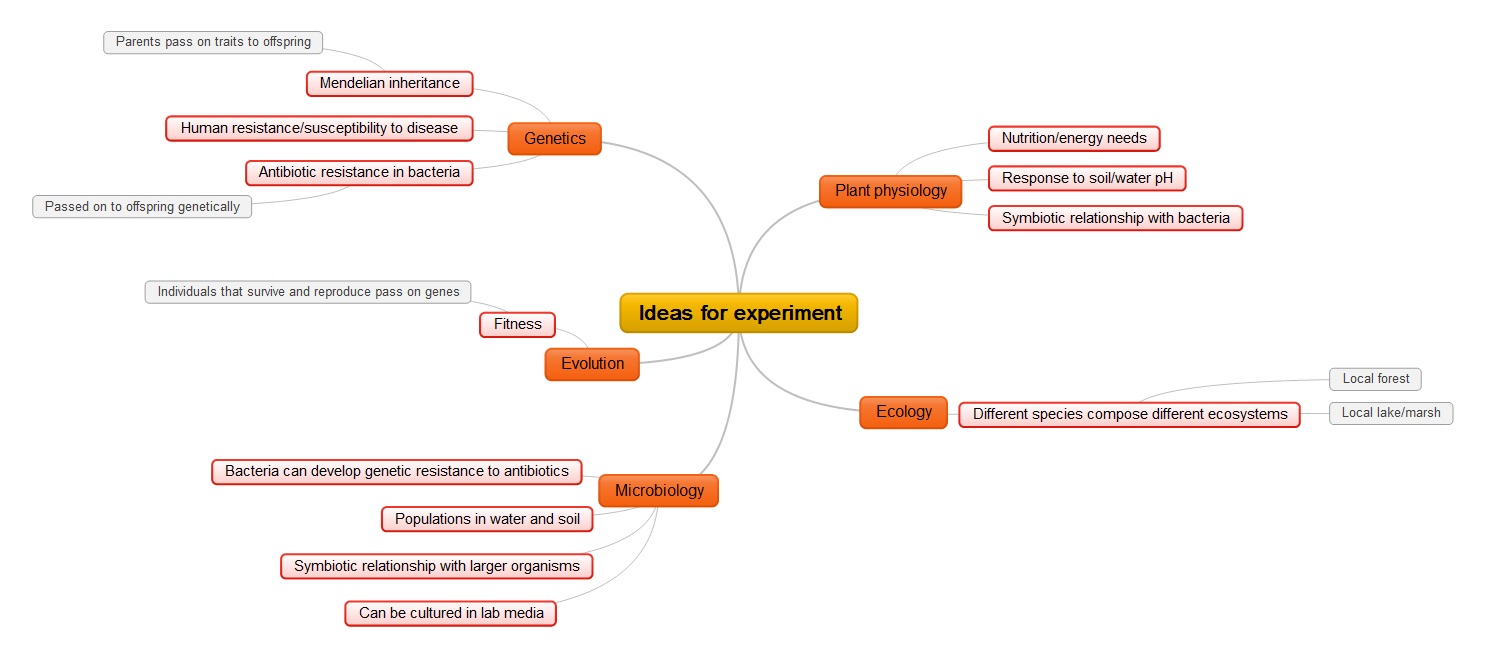
For example, consider students in a high school biology class who are asked to design an experiment to answer a scientific question of their choice. Ideally, the assignment provides students a way to engage with course material, asking difficult and interesting questions that perhaps haven't been asked before. How can we encourage to interact with knowledge in a dynamic way, especially in today's world of standardized testing and rigid curricula. Mind mapping - and associated educational software - can help inspire minds and keep kids engaged. The mind map begins with the general topics covered in class ...
... and proceeds to expand these ideas into more specific concepts and related details. The branched structure of the mind map makes it an excellent tool for categorizing information.
What mind mapping offers uniquely is the opportunity to make connections between these various branches and concepts. After expanding these biology topics, students begin to notice connections between some of them - micro-organisms provide a good system for studying genetics and selection/fitness, and are also an integral part of the ecosystem. The mind map illustrates these connections with arrows and creates new topics for experiment ideas.
One of the greatest benefits of mind mapping is flexibility. Reorganizing the elements of the map is as simple as clicking and dragging. There's space for continued development in every region of the map, allowing your brain to see connections between different map branches, and develop those connections into creative ideas. Ultimately, it can be a pretty useful tool, and MindMaple software is worth checking out.
MindMaple, Inc. are the makers of MindMaple software. These maps were made using MindMaple Lite, a free software available from www.mindmaple.com
NOTE: This entry is a Guest Post sponsored by MindMaple, Inc.
"Creating People On Whom Nothing is Lost" - An educator and writer in Colorado offers insight and perspective on education, parenting, politics, pop culture, and contemporary American life. Disclaimer - The views expressed on this site are my own and do not represent the views of my employer.
Wednesday, July 18, 2012
Tuesday, July 17, 2012
Next Food Network Star 2012 - Four Finalists Shoot Pilots?
The Food Network's Next Food Network Star wrapped up the competitive elements this week with the elimination of Ippy and Nikki while three finalists were supposed to shoot pilots to be judged and voted upon this week, leading to next week's finale. Of course, in keeping with Bob and Susie's inexplicable obsession with Marti, the rules were broken and an exception was made to allow four finalists to shoot pilots - Justin, Michelle, Yvan, and ..... ugh .... Marti. Alas, it's mystifying.
Of course, in the end with all the weeks of competition completed, the clear winner of Next Food Network Star is obvious - Justin is the only one truly ready to step in and headline a show. And, I must acknowledge that his pilot paying homage to the style of Alton Brown was quite an insightful move, as Justin's quirky style/look/POV, along with his extensive culinary knowledge and skill make him an obvious heir apparent to Alton. The pilot was clever, the dish was amazing, and his persona is ready for a time slot on the Food Network. Thus, Justin is the obvious pick from throughout the competition. Hell, he basically competed twice each week - once on his own and a second time as coach, teacher, surrogate, and savior to Marti.
NOTE - Hopefully, it's real time slot and he doesn't get stuck with a pathetic Sunday morning hour so Guy Fieri can continue to have basically his own channel in the evenings.
However, I would be equally comfortable sitting down in the evenings for a little Michelle and "My New England." Michelle's pilot was top notch. She had that flair and ease in front of the camera that was so evident when she "auditioned" for Bobby. And, there is so much that could be done with a show about the New England that we don't know. She could do a Guy-style show for NE. (NOTE - Just like Jeff the Sandwich King could - if the producers had a brain - do a Guy-style show for sandwiches. Anyway. My gut tells me that if Justin wins, Michelle will still get her own show. It only makes sense. She has great presence and a great POV.
As far as, Yvan? Well, I think we all like him, and his show would be interesting. But I cannot agree with sending him to the finals when he completely changed his POV on the last night of competition. Where did this "Yvan's Family Style" stuff come from? He was about cooking from the heart - but in small plates with stories from his youth. Now, he's all about cooking family style. As much as I like him and wish him well, that story doesn't work for me - and I won't watch the show. Marti - enough said really. Marti is not a chef. She has no culinary POV or skill. And the Food Network does not need a party planner. Marti needs to go back to whatever little nell she left to visit the big city, and she needs to stop wasting our time.
Thus, it should be Justin. And hopefully Michelle gets a shot, too. Justin already has a thriving career as a restaurateur - at the age of twenty-six. So, he's ready and can handle the pressure. Here's to you rebel. Hope the country agrees.
Friday, July 13, 2012
Is School Too Easy?
School is too easy. That's the word on the street these days from students themselves, as the results of a study from the Center for American Progress were released to a great deal of discussion - and criticism of public schools. According to the results of student surveys, many students nationwide "are not being challenged" in schools. This would seem to contradict the data about student test scores dropping, or students falling behind, or the dropout rate holding steady. If it's too easy, shouldn't everyone be doing well? Or are the classes too easy, and that's why the students don't do well when tested by outside forces. Certainly, the ACT/SAT are of concern. However, I would take exception to relying on tests such as the NAEP or even state tests. Any test that doesn't have student accountability is not a reliable measure of student learning.
The more interesting question for me this week was well articulated by Anthony Cody at EdWeek who wonders if "School can be too easy AND too hard." From a teacher's view, Cody aptly describes the conundrum of our varied school system with inconsistent standards across states and grade levels and even within single schools and departments. There is, of course, no way that any of my AP Language students would claim that school is "too easy." Not a chance. But, they are being held accountable in serious ways, and they have very high post-graduate aspirations. Even my CP level kids work diligently in my class, and complain that they should get honors credit - until they learn what my AP kids are doing.
School can be too easy in some ways - such as levels of homework or the number of essays written - and too hard in others such as the teaching of algebra in middle school or college classes in high school or textbooks written in manners which defy the knowledge and abilities of the average teenager. I know that the ability of some high school sophomores to pass AP World History or any high school student to handle AP Calculus or AP Bio defies any criticism that "school is too easy." But when statistics about the number of rigorous courses in high school indicate that the average high school senior takes as few as two core academic classes all year, it's not hard to accept that some schools in some places at some time for some kids is way too easy.
Wednesday, July 11, 2012
Online Learning - Coursera, Khan Academy, and Education Portal
Online learning has been around for almost as long as the internet. In fact, the earliest forms of electronic higher education were probably adaptations of the old correspondence course model used by universities to enable students to catch up on missed classes or get general requirements out of the way without interfering with regular school schedules. Working people could also acquire higher education credits and skilled labor credentials this way. We've certainly come a long way with the rise of online universities like Phoenix.
The latest developments come with the rise of online classes and tutoring designed to close education gaps and increase access to higher education. The rise of Sal Khan's Academy is one of the most prominent and exciting of these forums, and Khan Academy is one that has been written about extensively. I am incredibly impressed with what Sal Khan has been able to accomplish, and keeping with "a teacher's view" that whatever works is good practice, I am happy to see the Khan Academy grow and offer greater access to knowledge and education. A logical development of this, about which I've written before, is the offerings from Coursera, which is offering full curricula and certificate programs for online completion of bachelor degree programs at revered institutions such as University of Michigan, Columbia, and Stanford.
Another entrant into the world on free online classes is the Education Portal Academy - an online company about which I just learned. I don't have much experience or knowledge of their classes, but at first glance, EPA appears to offer free online tutorials in all sorts of subjects and skills - in much the same vein as Khan Academy. The difference appears to be that Education Portal is also operating as a bridge to college credits, and so there is a business motive that is not present in Khan, which is funded privately by groups such as the Gates Foundation. Regardless of the model, though, Education Portal seems to have some quality online resources available, and they may be poised to become a bigger player in online education.
Monday, July 9, 2012
"I'm Farming and I Grow It" - A Teacher's View
Americans have little connection to their food - and that may be part of our problem. This gap in our knowledge has been at the heart of arguments made by people like Michael Pollan in the book Omnivore's Dilemma and the movie Food, Inc. Americans have a poor diet of predominantly processed foods because they don't even know what "real food" is anymore. Well, it's grown on a farm by people like Greg Patterson and his brothers. Greg, a student at Kansas State University, was annoyed one day at a drive-in restaurant when he heard the radio playing I'm Sexy and I Know It. Greg - from a Kansas farm family - began rapping a new refrain - "I'm Farming and I Grow It."
Eventually, Greg and his brothers would craft enough lyrics for the full song, and proceeded to produce a video parody, which has gone viral on YouTube. According to Greg, they posted it to Facebook for some of their city friends who don't know anything about farming. In turn, they ended up educating millions about the hard work of farming. And, that's what I like about this video - it's farming and agriculture from "a teacher's view." Farming is important and hard work that is under appreciated by too many. And, I am hoping that a better press campaign for farming can pick up on this video sensation. Of course, I'd hope that more people turning to farming would be interested in organic farming and more natural practices. For example, I was pleased to see the cows eating grass, or hay, as opposed to corn or feed. That's not to say they don't also eat feed. But I'm hopeful.
Patterson's video reminds us that one farmer regularly feeds more than one hundred million people, and the country often has little appreciation for the hard work of men and women in the Heartland. And we should. Of course, I am not offering some schmaltzy idealistic image of farmers as being these perfect hardworking people. Farmers are like all people - they have their flaws. But the work is hard, and it's valuable, and we under appreciate it. And, that goes for all the migrant workers picking our fruits and vegetables, too.
So, if you ate today, thank a farmer.
Next Food Network Star 2012 - Martita
Food Network fans will not be served up episodes of "Martita's Mesa" - a great relief to many of us who knew that the camera-frozen Martita did not have star quality. For a young woman with not much culinary background, she went surprisingly far in the competition. Ultimately, she lost in a producers's challenge to Ippy, who is not much better for the long run. But Martita - whose accent mysteriously appears at the start and end of presentations only - really had nothing to offer.
Giadia DeLaurentis continues to embarrass herself, coming off like a catty middle schooler as she coaches and cheers on "her team." Neither Alton Brown nor Bobby Flay were seen coaching and cajoling and leading their people through the live presentations on Sunday, but Giadia couldn't sit still and cheered wildly when Yvan handled a simple microphone malfunction. Giada just wants to win this competition - exposing a surprising insecurity - and isn't really about finding the Next Food Network Star. I used to really enjoy her shows, but this season has really turned me off to Giada.
And about those "challenges." Each contestant was supposed to face an obstacle during their set to throw them off their game. And Michelle, Ippy, and Justin faced some tough challenges. Michelle's was the worst of all with having no idea what the time was and a cameraman acting crazy. But Yvan had a simple microphone go out. That was not a difficult problem. And a technician ran up with a replacement - which he "heroically" waved off. And Marti was missing an ingredient. Oh, big deal. I saw nothing impressive in the response of Yvan and Marti because any adult could have dealt with that. Had Marti faced Michelle's problem, she would have broken down in tears.
And let's say it again. Marti cannot cook. She is not a Food Network Star. She has no culinary training. She makes the most simple of dishes. She doesn't "teach" an audience anything. For goodness sakes, she made "Fish in a Bag." That takes no skills, and she can't even make it interesting. The folksy party schtick is wearing thin, and I do not understand why Bob and Susie find her interesting.
The competition still is - and should be - between Justin and Michelle. They are the only potential Next Food Network Stars.
Giadia DeLaurentis continues to embarrass herself, coming off like a catty middle schooler as she coaches and cheers on "her team." Neither Alton Brown nor Bobby Flay were seen coaching and cajoling and leading their people through the live presentations on Sunday, but Giadia couldn't sit still and cheered wildly when Yvan handled a simple microphone malfunction. Giada just wants to win this competition - exposing a surprising insecurity - and isn't really about finding the Next Food Network Star. I used to really enjoy her shows, but this season has really turned me off to Giada.
And about those "challenges." Each contestant was supposed to face an obstacle during their set to throw them off their game. And Michelle, Ippy, and Justin faced some tough challenges. Michelle's was the worst of all with having no idea what the time was and a cameraman acting crazy. But Yvan had a simple microphone go out. That was not a difficult problem. And a technician ran up with a replacement - which he "heroically" waved off. And Marti was missing an ingredient. Oh, big deal. I saw nothing impressive in the response of Yvan and Marti because any adult could have dealt with that. Had Marti faced Michelle's problem, she would have broken down in tears.
And let's say it again. Marti cannot cook. She is not a Food Network Star. She has no culinary training. She makes the most simple of dishes. She doesn't "teach" an audience anything. For goodness sakes, she made "Fish in a Bag." That takes no skills, and she can't even make it interesting. The folksy party schtick is wearing thin, and I do not understand why Bob and Susie find her interesting.
The competition still is - and should be - between Justin and Michelle. They are the only potential Next Food Network Stars.
Saturday, July 7, 2012
Coursera and the 21st Century Classroom
After posting recently about the rise of Coursera - or the availability of full university curricula in certificate form - I was sent this graphic about the 21st Century classroom. The significance is clear, as online learning is changing the classroom rapidly, and that will impact the way higher education is funded and delivered. The following image and explanation was created by Open Colleges, one "of Australia's leading providers of distance learning." The concept of distance learning is not going away, and with the rise of organizations such as the Khan Academy and Coursera, educators are going to need to adapt to the shifting infrastructure.
![]() |
Friday, July 6, 2012
Right Brain Rising - Push for Creativity in the Classroom
Though I'm quite the traditionalist in the classroom, I've been trying to push for more creativity in the classroom for quite a few years now - ever since I completed the Colorado Writing Project staff development and attended a poetry conference led by Georgia Heard. Since then I have added multi-genre research papers to my writing instruction, and I ask my honors English freshman to engage in interpretive dance during our poetry unit. Each year I am more and more surprised by how truly insightful and creative my students are - and can be - when given the opportunity.
The importance of creativity is explored in a new book by Tony Wagner called Creating Innovators: The Making of Young People Who Will Change the World. Wagner's first book The Global Achievement Gap was instrumental in developing the concept of 21st-century skills and encouraging a development in our outdated curricula from the 19th-century model. It was eye-opening for me and many teachers, and while critics argue that it waters down classic education, his ideas seem valid to me. His new book is targeted toward "Waldorf parents, Montesori moms, and Koala dads," and while I am sometimes put off by too much of a child-centered discovery approach, Wagner's ideas are worth considering. Innovation has always been the strength of America and the key to our success.
As the push for right-brain thinking and creativity in the classroom continues, take a look at what the Lowell Milken Center is doing as well.
* thanks to Joanne Jacobs
The importance of creativity is explored in a new book by Tony Wagner called Creating Innovators: The Making of Young People Who Will Change the World. Wagner's first book The Global Achievement Gap was instrumental in developing the concept of 21st-century skills and encouraging a development in our outdated curricula from the 19th-century model. It was eye-opening for me and many teachers, and while critics argue that it waters down classic education, his ideas seem valid to me. His new book is targeted toward "Waldorf parents, Montesori moms, and Koala dads," and while I am sometimes put off by too much of a child-centered discovery approach, Wagner's ideas are worth considering. Innovation has always been the strength of America and the key to our success.
As the push for right-brain thinking and creativity in the classroom continues, take a look at what the Lowell Milken Center is doing as well.
* thanks to Joanne Jacobs
Monday, July 2, 2012
Next Food Network Star 2012 - Malcolm Goes Home
Who will be the Next Food Network Star? Not Malcolm.
Malcolm went home last night after an intra-team square-off against Michelle following the beach party competition. Of course, it makes sense that Malcolm finally goes home because, while he is an exceptional executive chef and reasonably comfortable on camera, Malcolm never had a point of view. POV is the key to success in this competition, and his idea of "cooking with soul" but not necessarily cooking "soul food" was just confusing and ultimately unmarketable. Michelle survived, which makes sense because she was initially the one with the most star quality - great culinary skill, solid point of view with My New England, and completely comfortable on camera. I disagree with Bob and Susie that New England is too narrow for a show, and Michelle opened that up this week.
As far as this week's show and competition? Well, let's put it out there - Paula Deen is gross.
The idea of heading for Miami - with the goal of being there for the Miami Food and Wine Classic - and then bringing in Paula Deen is baffling to me. For a network that is committed to culinary arts and high quality cuisine, the Paula Deen angle is depressing. I realize she's popular - but so is McDonalds. And Paula Deen brings nothing but crass personality and disgustingly unhealthy food to the table. She certainly sells well among the Walmart and McD's crowd, but she has no business rubbing elbows with Bobby Flay, Alton Brown, and Giada. And her fuzzy little connection with Marty was annoying at best.
So, about Marty. I do not understand the judges' fascination with this woman. It's like the story of Herb from a couple seasons back - where they kept him around with some bizarre hope of a show for a new demographic. But he could neither bring it in the kitchen nor handle himself on camera. And with Marty, let's be clear: this woman cannot cook. Her offerings are so simple they could be done in an Easy-Bake Oven, and Justin has saved her butt countless times in this competition. Additionally, she simply randoms along in her camera moments and apparently the only appealing quality is her accent and self-deprecating stories. But intentionally mispronouncing the names of classic dishes and techniques is not impressive and it's not Food Network Star material. My only explanation for this woman's "stickiness" is that the Food Network thinks they have the next PD in the making, and they don't want to lose the tater-tot casserole crowd. For my part, cut her loose.
Clearly, Justin is still the only contestant who has consistently shown star quality - though I'd like to see Michelle come on. Ippy won this week, and he certainly deserved it. But he is not a Food Network Star. Yvan was reasonably successful, but Martita has to go. The only thing Martita has going for her is the way she says her name to open and blowing kisses at the end. In between she is completely flat - and the Mexican food angle is already saturated. She's nothing special there. Finally, thank goodness Nikki finally pronounces the "grill-lll" next door. Other interesting points from the show that I liked were the comments from Ippy, Yvan, and Martita that when they grew up the kids ate what the adults did. I really like that commentary.
So, Malcolm is not the Next Food Network Star, and hopefully next week we will finally learn that Marty will not be the Next Food Network Star. And, regardless of who wins, I'd like to reiterate my hope that the Next Food Network Star starts getting some air time, so the Food Network can stop being the Guy Fieri Network. Diners, Drive-ins, & Dives is nice, but Jeff the Sandwich King could do the same thing at least one night a week for Sandwiches.
Malcolm went home last night after an intra-team square-off against Michelle following the beach party competition. Of course, it makes sense that Malcolm finally goes home because, while he is an exceptional executive chef and reasonably comfortable on camera, Malcolm never had a point of view. POV is the key to success in this competition, and his idea of "cooking with soul" but not necessarily cooking "soul food" was just confusing and ultimately unmarketable. Michelle survived, which makes sense because she was initially the one with the most star quality - great culinary skill, solid point of view with My New England, and completely comfortable on camera. I disagree with Bob and Susie that New England is too narrow for a show, and Michelle opened that up this week.
As far as this week's show and competition? Well, let's put it out there - Paula Deen is gross.
The idea of heading for Miami - with the goal of being there for the Miami Food and Wine Classic - and then bringing in Paula Deen is baffling to me. For a network that is committed to culinary arts and high quality cuisine, the Paula Deen angle is depressing. I realize she's popular - but so is McDonalds. And Paula Deen brings nothing but crass personality and disgustingly unhealthy food to the table. She certainly sells well among the Walmart and McD's crowd, but she has no business rubbing elbows with Bobby Flay, Alton Brown, and Giada. And her fuzzy little connection with Marty was annoying at best.
So, about Marty. I do not understand the judges' fascination with this woman. It's like the story of Herb from a couple seasons back - where they kept him around with some bizarre hope of a show for a new demographic. But he could neither bring it in the kitchen nor handle himself on camera. And with Marty, let's be clear: this woman cannot cook. Her offerings are so simple they could be done in an Easy-Bake Oven, and Justin has saved her butt countless times in this competition. Additionally, she simply randoms along in her camera moments and apparently the only appealing quality is her accent and self-deprecating stories. But intentionally mispronouncing the names of classic dishes and techniques is not impressive and it's not Food Network Star material. My only explanation for this woman's "stickiness" is that the Food Network thinks they have the next PD in the making, and they don't want to lose the tater-tot casserole crowd. For my part, cut her loose.
Clearly, Justin is still the only contestant who has consistently shown star quality - though I'd like to see Michelle come on. Ippy won this week, and he certainly deserved it. But he is not a Food Network Star. Yvan was reasonably successful, but Martita has to go. The only thing Martita has going for her is the way she says her name to open and blowing kisses at the end. In between she is completely flat - and the Mexican food angle is already saturated. She's nothing special there. Finally, thank goodness Nikki finally pronounces the "grill-lll" next door. Other interesting points from the show that I liked were the comments from Ippy, Yvan, and Martita that when they grew up the kids ate what the adults did. I really like that commentary.
So, Malcolm is not the Next Food Network Star, and hopefully next week we will finally learn that Marty will not be the Next Food Network Star. And, regardless of who wins, I'd like to reiterate my hope that the Next Food Network Star starts getting some air time, so the Food Network can stop being the Guy Fieri Network. Diners, Drive-ins, & Dives is nice, but Jeff the Sandwich King could do the same thing at least one night a week for Sandwiches.
Sunday, July 1, 2012
Lowell Milken Center Discovery Award
Discover An Unsung Hero with the Lowell Milken Center
Innovation has always been the key to America's success. Innovation and creativity are integral to the American spirit, and they have been the foundation that has led the United States to greatness for more than two hundred years. As an educator I have written often of the importance of creativity, innovation, and discovery in the classroom. From the speeches of Sir Ken Robinson to the writings of Malcolm Gladwell and Daniel Pink to my own experience with multi-genre writing and multi-genre research projects, I have tried to promote an emphasis on creativity and innovation in the classroom.
In the world of education reform, project-based learning has gained increased attention over the years as teachers and reformers seek ways to the move our classrooms away from the monotony of textbook-based lesson plans and the all-too-common lecture. Students are naturally creative and unique individuals, and, thus, many struggle with a one-size-fits all education model that is, in many ways, based on 19th-century thinking. On the other hand, giving students a path and an interactive way in which to make their journey unleashes their creativity and engagement with learning, regardless of the subject. It's like making students into explorers and adventurers - and that's far more intriguing than being note and test takers.
One little-known organization that has been working hard to share and promote the power of project-based learning is the Lowell Milken Center. Named for and founded by education philanthropist Lowell Milken in 2007, the Kansas-based organization has been churning out rather impressive projects that have resulted in national and world news coverage. And, now, they are offering students the chance to win a whopping $10,000 for their efforts in uncovering an unknown historical figure. $10,000. That is huge. And, I am impressed with an organization that is so committed to creativity and innovation that they are willing to honor student work in such a way.
The winners of the Inaugural year of the Lowell Milken Center Discovery Award will be announced this July, and I can't wait to see what history students and teachers have come up with in pursuit of this goal. If you haven't yet heard about this award, the Lowell Milken Center asked students across America to create projects around the story of an unsung hero who has changed history. The really cool part is that students can present their discovery in a variety of genres such as documentary film, a performance, an exhibit, or a website. That multi-genre angle is what really caught my interest and inspires me about this organization and this contest. Far too often, these contests are essay-based, and that requirement turns off many creative and insightful students. Students today have much to say, and they can do so in a variety of engaging and professional multi-media formats. It is truly amazing to see what a group of young people can discover and produce when given the opportunity and a supportive teacher along for the journey.
This approach reminds me of the multi-genre research projects my students have done in our study of individuality and the American spirit. Rather than complete an essay or research paper like they've done for countless classes, I encouraged them to research their information and then present it in whatever genres speak to them. This lesson always produces their best work of the year. Additionally, such an approach is much more real-world practical and represents the type of educational model we need for 21st-century learning. So, I encourage you to check out the Lowell Milken Center and the Lowell Milken Center Discovery Award. I know I am going to promote this organization and its award to my students and colleagues. I hope parents and teachers encourage their students to take advantage of this cool and exciting opportunity.
The Lowell Milken Center Discovery Award is the type of creative and innovative thinking that will help improve American education.
NOTE: This entry is a Guest Post sponsored by the Lowell Milken Center
Innovation has always been the key to America's success. Innovation and creativity are integral to the American spirit, and they have been the foundation that has led the United States to greatness for more than two hundred years. As an educator I have written often of the importance of creativity, innovation, and discovery in the classroom. From the speeches of Sir Ken Robinson to the writings of Malcolm Gladwell and Daniel Pink to my own experience with multi-genre writing and multi-genre research projects, I have tried to promote an emphasis on creativity and innovation in the classroom.
In the world of education reform, project-based learning has gained increased attention over the years as teachers and reformers seek ways to the move our classrooms away from the monotony of textbook-based lesson plans and the all-too-common lecture. Students are naturally creative and unique individuals, and, thus, many struggle with a one-size-fits all education model that is, in many ways, based on 19th-century thinking. On the other hand, giving students a path and an interactive way in which to make their journey unleashes their creativity and engagement with learning, regardless of the subject. It's like making students into explorers and adventurers - and that's far more intriguing than being note and test takers.
One little-known organization that has been working hard to share and promote the power of project-based learning is the Lowell Milken Center. Named for and founded by education philanthropist Lowell Milken in 2007, the Kansas-based organization has been churning out rather impressive projects that have resulted in national and world news coverage. And, now, they are offering students the chance to win a whopping $10,000 for their efforts in uncovering an unknown historical figure. $10,000. That is huge. And, I am impressed with an organization that is so committed to creativity and innovation that they are willing to honor student work in such a way.
The winners of the Inaugural year of the Lowell Milken Center Discovery Award will be announced this July, and I can't wait to see what history students and teachers have come up with in pursuit of this goal. If you haven't yet heard about this award, the Lowell Milken Center asked students across America to create projects around the story of an unsung hero who has changed history. The really cool part is that students can present their discovery in a variety of genres such as documentary film, a performance, an exhibit, or a website. That multi-genre angle is what really caught my interest and inspires me about this organization and this contest. Far too often, these contests are essay-based, and that requirement turns off many creative and insightful students. Students today have much to say, and they can do so in a variety of engaging and professional multi-media formats. It is truly amazing to see what a group of young people can discover and produce when given the opportunity and a supportive teacher along for the journey.
This approach reminds me of the multi-genre research projects my students have done in our study of individuality and the American spirit. Rather than complete an essay or research paper like they've done for countless classes, I encouraged them to research their information and then present it in whatever genres speak to them. This lesson always produces their best work of the year. Additionally, such an approach is much more real-world practical and represents the type of educational model we need for 21st-century learning. So, I encourage you to check out the Lowell Milken Center and the Lowell Milken Center Discovery Award. I know I am going to promote this organization and its award to my students and colleagues. I hope parents and teachers encourage their students to take advantage of this cool and exciting opportunity.
The Lowell Milken Center Discovery Award is the type of creative and innovative thinking that will help improve American education.
NOTE: This entry is a Guest Post sponsored by the Lowell Milken Center
Thursday, June 28, 2012
Good Student, Good Teacher, Good School
As part of a recent research project, I have been asking people how they define:
"a good student"
"a good teacher"
"a good school"
The general consensus about a good student is that he or she is pretty self motivated. In fact, nearly every explanation expressed very high expectations for a "good student." Good students are curious and generally interested in learning. They are responsible and self aware, needing less supervision and encouragement than others. They do their work on time and strive to always produce high quality work. They are also respectful and, in a word, nice. Interestingly, the issue of intelligence did not come up at all - thus, the definition of a good student seems much more geared around a natural interest and engagement with learning and a lot of diligence.
A good teacher, by most accounts, can be judged by two criteria: content knowledge and engaging personality. It could be that simple, which is easily identifiable in one regard and nearly impossible to quantify in the other. Teachers need to know their subject well in order to teach it. And the fact that this is such a common expectation makes me wonder if there are a lot of unqualified teachers out there. Actually, I don't wonder. I know, and lament, that it is true. The engaging personality component is the primary reason that the Gates Foundation will continue to struggle with their model of identifying great teachers. In many ways, it seems innate and almost unteachable. Are good teachers born, not made?
It seems only likely that if a school has good students and good teachers, it will be a good school. Of course, most of the data shows that a good school is most likely found in safe, upper class neighborhoods. However, plenty of good schools rise above their neighborhood and produce good results because of a shared vision of excellence throughout the school community. That is most often seen in successful charter schools - though the charter model is by no means a guarantee of a good or successful school. My research finds that a good school is above all a safe and caring environment that offers all students the opportunity to succeed.
What do you think?
"a good student"
"a good teacher"
"a good school"
The general consensus about a good student is that he or she is pretty self motivated. In fact, nearly every explanation expressed very high expectations for a "good student." Good students are curious and generally interested in learning. They are responsible and self aware, needing less supervision and encouragement than others. They do their work on time and strive to always produce high quality work. They are also respectful and, in a word, nice. Interestingly, the issue of intelligence did not come up at all - thus, the definition of a good student seems much more geared around a natural interest and engagement with learning and a lot of diligence.
A good teacher, by most accounts, can be judged by two criteria: content knowledge and engaging personality. It could be that simple, which is easily identifiable in one regard and nearly impossible to quantify in the other. Teachers need to know their subject well in order to teach it. And the fact that this is such a common expectation makes me wonder if there are a lot of unqualified teachers out there. Actually, I don't wonder. I know, and lament, that it is true. The engaging personality component is the primary reason that the Gates Foundation will continue to struggle with their model of identifying great teachers. In many ways, it seems innate and almost unteachable. Are good teachers born, not made?
It seems only likely that if a school has good students and good teachers, it will be a good school. Of course, most of the data shows that a good school is most likely found in safe, upper class neighborhoods. However, plenty of good schools rise above their neighborhood and produce good results because of a shared vision of excellence throughout the school community. That is most often seen in successful charter schools - though the charter model is by no means a guarantee of a good or successful school. My research finds that a good school is above all a safe and caring environment that offers all students the opportunity to succeed.
What do you think?
Sunday, June 24, 2012
Matt Continues to Dance
Years ago, I was introduced to the video "Where in the Hell is Matt," which chronicled a man who danced his crazy little dance wherever he was in the world. It went viral and made a great statement. Now, Matt is back with a new version. And there's "nothing left to do but smile, smile, smile.
Keep dancing, Matt.
And everyone.
Keep dancing, Matt.
And everyone.
Friday, June 22, 2012
Bus Monitor Bullies are not "Good Kids"
Every once in a while a news story on children behaving badly goes viral, and we're all given a sad bit of insight into the dark side of the human spirit and the stupidity of youth. The latest incident is the group of middle schoolers who taunted, ridiculed, threatened, and demeaned a 68-year-old bus monitor, and then posted a video of their exploits on Facebook. The public reaction - and outrage - has been swift and animated. Matt Lauer on the Today Show called the kids "little monsters," and a website originally created to raise money to send the woman on a vacation has, at last count, raised nearly a half-million dollars. While the school has yet to discipline the cruel, small-minded tweens, one father is reporting that his family is receiving death threats. Clearly, that has gone too far.
But I have to wonder about the father who says his son "made a mistake."
The bus monitor bullies did not make a mistake - they made a conscious choice to be cruel. They didn't accidentally insult this 68-year-old woman - they chose to be mean, they chose to psychologically brutalize a weaker person, they chose to victimize a human they saw as beneath them, they chose to be awful human beings. This father has said his "heart was broken" when he viewed the despicable behavior of his child. Sadly, he came face-to-face with his son's nature - and it's not a pretty picture. Some will take exception to my criticism of these boys - because they truly are young and naive and clueless about the pain they were causing. But these boys are mean and nasty individuals who, for some reason, lack any degree of empathy and the most basic level of human decency. They are not good kids.
The bus monitor bullies' incident reminded of another example of atrocious teen behavior that happened in the upper class Chicago suburb of Northbrook about ten years ago. A girls powder puff football game that was established as a ritual where the senior girls hand the school over to the juniors degraded into brutal hazing incident which resulted in girls being hospitalized with concussions and broken bones. In one of the more disturbing aspects of the incident, the younger girls had buckets and coolers filled with fish guts, fish blood, urine, and human feces poured over their heads. To add to the insanity, some of the girls were beat over the heads with the buckets, and some of the girls with concussions required up to ten stitches. It was a disaster of human behavior which generated the same sort of outrage as the bus monitor bullies. However, the aspect that really got under my skin was comments from some parents of the senior girls who said, "They're not bad kids - they're good kids who made a mistake."
Whoa, there, Nelly.
These are not good kids, and this was not a mistake. They are actually rather self-absorbed, obnoxious, cruel, manipulative, mean-spirited, and shallow young women. They are not nice people. They apparently take some sort of sick twisted pleasure from brutalizing others and seeing people suffer. They have no empathy and they have no self control. That is not, in my opinion, the behavior of a "good kid." And brutalizing a person is not a mistake. It is a representation of who you are - in your heart - even if that means you are simply an incredibly shallow and careless person. But that's who these girls are. So, let's not try to justify it. Let's not claim it was about the alcohol. Let's not pretend that mob action can be justified. That part of their nature is indefensible. And, while it does not represent the whole sum of their lives and personalities, it is a very significant part of who they are.
That said, I do not believe that these "children" are beyond redemption. People can change ... their behavior. They can be taught to control and manage that dark side. But that darkness is in their hearts, and it cannot be explained away or justified.
Monday, June 18, 2012
The Next Food Network Star - Linky Goes Home
Not surprisingly to veteran viewers of the reality competition for who will be the "next" Food Network Star, Linky - the pastry chef with South African roots - was eliminated last night. The basic reason for her failure was the inability to speak in front of the camera. Additionally, critics might argue that she never really had a point of view, was not that skilled as a chef, and had been hanging around for weeks simply because her team was doing well enough to protect her. Of course, with Linky coming from Team Giada, the team argument is weak because I still can't understand how some of these people have stuck around. Like Linky, Ippy has no camera presence at all and he never will. Martita is really not that interesting and her point of view - the Latina chef - is already well represented on the Food Network. Yvan is coming along ... but he's still not going to be star quality.
It really comes down to the ability to be engaging and interesting in front of a crowd. That simple trait goes back to the all important angle taken by Alton Brown in his initial screening. He wanted the chefs to "teach him something" because that is what a Food Network Star needs to do. And that was much appreciated by A Teachers View, as people don't often consider the significance of that quality. It is an EQ - or emotional intelligence - issue, rather than an IQ or skill. Not surprisingly, many intelligent and skilled people leave teaching - or never pursue it - because standing in front and being able to engage a group is quite tough. It's extremely challenging when you have a reluctant audience of young people. But it can be as tough for someone like a Food Network Star who has a very demanding and critical audience who will quickly change the channel if they don't like and buy what you're selling.
So, clearly, Linky didn't have "it."
Food Network Cookbook Holder
It really comes down to the ability to be engaging and interesting in front of a crowd. That simple trait goes back to the all important angle taken by Alton Brown in his initial screening. He wanted the chefs to "teach him something" because that is what a Food Network Star needs to do. And that was much appreciated by A Teachers View, as people don't often consider the significance of that quality. It is an EQ - or emotional intelligence - issue, rather than an IQ or skill. Not surprisingly, many intelligent and skilled people leave teaching - or never pursue it - because standing in front and being able to engage a group is quite tough. It's extremely challenging when you have a reluctant audience of young people. But it can be as tough for someone like a Food Network Star who has a very demanding and critical audience who will quickly change the channel if they don't like and buy what you're selling.
So, clearly, Linky didn't have "it."
Food Network Cookbook Holder
Sunday, June 17, 2012
Are Video Games Education?
Over the years, I have had various students who are video game players and enthusiasts, and the more astute of them have often argued for the educational value of video games. This idea has been gaining traction in the field because of the basic concepts of risk/reward, critical thinking, improvement through increasing levels and challenges, and teamwork. Additionally, I occasionally encounter some very bright students who talk about game design as a career. While that may sound like a fantasy job, it is by no means a slacker career. In fact, it's mostly my advanced AP students who express a sincere interest in this career. Thus, the value of video games as education, and the value of game design as a credible career should be considered by any education advocates.
For more information check out this short 5-minute Film Festival of clips exploring the value of video games in schools. This presentation is from Edutopia - the site for the George Lucas Educational Foundation. It presents examples such as a middle school in New York in which all the traditional subjects are explored and learned through game design, or the STEM video game contest sponsored by the White House. In keeping with "a teacher's view" that whatever works in education is good policy, the idea of video games as education is worth considering.
Sunday, June 10, 2012
My Education Statement of Belief
In 1983 when the National Commission on Excellence in
Education released A Nation at Risk,
I was thirteen years old and preparing to enter high school. That report established my generation as the
first to suffer failing schools. It was
a call for action and change, and it forewarned of a coming national crisis. Yet, thirty years later, even as the nation
has survived several cycles of boom and bust, the public education system
remains largely intact. Even as the world has been reinvented through radical
growth in information technology, public education looks much as it has since
its inception. However, change is
incremental, and bringing innovation and progress to public education requires
informed, passionate, and prudent leadership, as well as a degree of patience
and commitment.
Certainly, the last thirty years have seen growth and
development in education policy, especially with the rise of charter schools
and various experiments in school choice.
Yet, despite numerous reform movements, not the least of which is the No
Child Left Behind Act, the system remains virtually unchanged. At times, that sort of intransigence can be
disheartening to reformers. However, it
shouldn’t be. There is much to praise
about American education, and there is also great potential for change. Margaret Mead said, “Never underestimate the power of a small group of committed citizens to
change the world. Indeed, it has never been done otherwise.” As an educator and leader in my community, I
seek to be one of those committed citizens.
The current K-16 model of a one-size-fits-all education
system is both outdated and inefficient for a nation as productive and
progressive as the United States. The
system is not at all representative of American society, a culture built on
diversity, innovation, and progress. Change
will come from the foundation of the American Dream – the notion of
opportunity. The greatest strength of
American society and American education is the notion of “access granted.” In Colorado, that idea is enshrined in the
state constitution, which calls for a “thorough and uniform education
system.” At the most basic level that
means equal opportunity for all students to access as much education as they
require and desire. As an educational
leader, I seek to promote the strengths of American education while modifying
its weak points, and my ultimate goal is summed up in the words of Washington
Post education writer Jay Matthews who believes “The best education for the
best is the best education for all.”
Having taught in Taiwan and in the United States, in both public
and private schools, in the city of Chicago as well as several suburbs, my
educational experience is diverse and informed. Ultimately, as an educational leader, I seek
to synthesize the best components of all systems into an exemplary system in
the United States. In the area of
educational leadership, I have established a strong voice through a career
dedicated to professional growth. In
twenty years of teaching classes ranging for ELA to developmental English to
college prep and AP English, I have seen it all. However, beyond the classroom, education policy has been a hobby of mine for years, and I
consider myself a bit of a policy geek. My
desire to become an educational leader and reformer came during a staff
development class on literacy when I discovered Chris Tovani’s book I Read It But I Don’t Get It. That exposure kicked off a reading revolution
in my classroom, and by the following year, my principal had purchased Tovani’s
book for the entire department. It was
about this time that I began contributing to the world of educational
commentary. Following the publication of
my first op-ed commentary on education – a piece for the Denver Post in which I
challenged Sean Hannity’s assertion that the public education system was in a
state of “ruin” – I discovered the world of education blogging, and truly began
to develop a mindset for education reform and leadership.
As a reformer in education I firmly believe in “whatever
works.” For example, in terms of charter schools, I’d consider the plan in Mark
Miller's book The 2% Solution, which
should appeal to both liberals and conservatives, because while it is focused
on achievement, it addresses the concerns of unions, which are made up of many
passionate and committed teachers. I’m also intrigued by reforms in the Adams
50 district, which challenge the tradition of “seat time” and “grade level.”
Any program that produces results should be supported and replicated.
Additionally, I would like for Colorado to take a sincere look at the
reforms in New Hampshire, which is moving toward a high school graduation at
sixteen for students entering associate degree programs and trade schools.
Students who stay in school for years 11 and 12 will take a rigorous AP/IB
college prep curriculum that seriously prepares them for the work of a
four-year college. This would radically cut down on the number of students
requiring remedial courses in college or the half who quit without earning a
degree. The reforms are adapted from the “Tough Choices, Tough Times”
report released by a coalition of education leaders and business professionals,
and it draws on the Asian and European models that are so often cited by
critics of the current system.
Sunday, June 3, 2012
The Next Food Network Star 2012 - Eric Goes Home
As much as I am enjoying the competition for who will be the Next Food Network Star 2012 on the Food Network, I have to think Bob and Susie made a big mistake in sending Napa executive chef Eric home this week after a producers challenge with Ippy. While both of these great chefs have a camera problem right now, Eric is clearly the far superior chef, and Bobby Flay made this obvious argument in the final segment. While Ippy from Team Giada is a good chef and a nice guy, he can not bring it on the camera in any meaningful way. Ultimately, I think Bob and Susie just felt like the Hawaiian angle is more marketable for the network. But it doesn't work for me, as neither of these two men was ever really going to be the Next Food Network Star.
Sadly, I would have liked to see Eric go farther in the competition simply because he is the superior chef. That should count for something because we're all tuning in to see people who can work culinary magic. And, while he has regularly struggled to finish his dishes, I always love what he's doing. Ippy, on the other hand, really doesn't have much of anything interesting going on. Despite the claims that he is simply laid back, like his culture, I am unimpressed. And, I can't figure out how Linkie didn't go home this week, and hasn't gone out yet. She is completely forgettable - except when I can't forget how poorly she stumbles through her presentations. The same goes for Yvan. Bob and Susie should just send him home - despite how well he does next week - because he simply will not be the Next Food Network Star. Ultimately, Eric and Ippy should go because it really is all about the camera presence and personality. All these people can cook, and the world has many magical chefs; but being able to engage an audience is the key, and that's really the answer to who will be the Next Food Network Star. It's like teaching - no matter how well you know your subject, you won't survive in the classroom if you can't bring it on the stage.
And, I have to again assert that I am not liking this celebrity chef team format at all. For one, Alton and Giada are clearly helping out their people quite a bit - and that's not the point of the show. Additionally, this format is really not flattering for Giada. She continues to come across as petty and desperate for the affection of her team and the need to simply win. It seems like she doesn't want to find the best Next Food Network Star, for she has had nothing positive to say about any other finalists. She just wants to win and she is coming across, quite honestly, as a real bitch. That's a shame because I never felt that way about her. So, Bob and Susie should definitely nix this format for next season.
So, Eric's out. Hopefully, Linkie or Yvan or Ippy go next.
*UPDATED
Judson is another example of the problem with the team format. As a reader recently pointed, he should have gone home last night as well. In fact, he was every bit as bad as Eric and Ippy on camera, and he's a much worse cook. Yet, he was protected because his team won. And, this wasn't even a team competition. It would almost be understandable if this - like last year - was an actual team event and his work somehow led to the team's win. But it wasn't. He was "safe" just by the default of having been picked by Alton. Otherwise, he's a standard cook with absolutely no marketable "point of view," or POV, and he has no camera presence at all. Everything he says sounds scripted - if not simply phony. So, Judson needs to go home soon.
However, I must acknowledge the winner from Team Alton - Justin. That kid just flat out rocks in the kitchen. And, I think the quirky creativity is definitely going to be an asset. My early favorite was Michelle. But, if she doesn't get out of her own head, Justin is going to steal this competition.
** UPDATE - For the most current breakdown on Malcolm's exit this week, check out my latest:
Sadly, I would have liked to see Eric go farther in the competition simply because he is the superior chef. That should count for something because we're all tuning in to see people who can work culinary magic. And, while he has regularly struggled to finish his dishes, I always love what he's doing. Ippy, on the other hand, really doesn't have much of anything interesting going on. Despite the claims that he is simply laid back, like his culture, I am unimpressed. And, I can't figure out how Linkie didn't go home this week, and hasn't gone out yet. She is completely forgettable - except when I can't forget how poorly she stumbles through her presentations. The same goes for Yvan. Bob and Susie should just send him home - despite how well he does next week - because he simply will not be the Next Food Network Star. Ultimately, Eric and Ippy should go because it really is all about the camera presence and personality. All these people can cook, and the world has many magical chefs; but being able to engage an audience is the key, and that's really the answer to who will be the Next Food Network Star. It's like teaching - no matter how well you know your subject, you won't survive in the classroom if you can't bring it on the stage.
And, I have to again assert that I am not liking this celebrity chef team format at all. For one, Alton and Giada are clearly helping out their people quite a bit - and that's not the point of the show. Additionally, this format is really not flattering for Giada. She continues to come across as petty and desperate for the affection of her team and the need to simply win. It seems like she doesn't want to find the best Next Food Network Star, for she has had nothing positive to say about any other finalists. She just wants to win and she is coming across, quite honestly, as a real bitch. That's a shame because I never felt that way about her. So, Bob and Susie should definitely nix this format for next season.
So, Eric's out. Hopefully, Linkie or Yvan or Ippy go next.
*UPDATED
Judson is another example of the problem with the team format. As a reader recently pointed, he should have gone home last night as well. In fact, he was every bit as bad as Eric and Ippy on camera, and he's a much worse cook. Yet, he was protected because his team won. And, this wasn't even a team competition. It would almost be understandable if this - like last year - was an actual team event and his work somehow led to the team's win. But it wasn't. He was "safe" just by the default of having been picked by Alton. Otherwise, he's a standard cook with absolutely no marketable "point of view," or POV, and he has no camera presence at all. Everything he says sounds scripted - if not simply phony. So, Judson needs to go home soon.
However, I must acknowledge the winner from Team Alton - Justin. That kid just flat out rocks in the kitchen. And, I think the quirky creativity is definitely going to be an asset. My early favorite was Michelle. But, if she doesn't get out of her own head, Justin is going to steal this competition.
** UPDATE - For the most current breakdown on Malcolm's exit this week, check out my latest:
Wednesday, May 30, 2012
Diane Ravitch on No Child Left Behind NCLB
About twelve years ago, as I became more interested in school policy and began reading education policy books and articles, I ran across the work of Jeanne Chall and Diane Ravitch. And my passion for education reform was born. Ravitch, especially, just made so much sense in her criticisms of the field of public education. And she was not willing to sugarcoat anything to protect teachers or any other special interest. That critical eye led her to her work in the Bush administration and her initial support of No Child Left Behind.
In recent years, however, Ravitch's views have changed, and she is not afraid of changing her mind. Despite a lot of criticism, Ravitch has some very sound arguments against the current state of education reform. If you haven't Diane Ravitch's criticism of No Child Left Behind, you should consider her ideas. In countless articles and speeches, Diane has exposed the problems of high stakes testing and free market reform efforts led by groups such as the Gates Foundation and the Walton Foundation. Ravitch published an extensive expose of the issue in her book - The Death and Life of the Great American School System: How Testing and Choice Undermined Public Education.
For a more succinct version of her criticism, check out this piece published on the NEA website. I ran across this link while reading Darren's post at RightOntheLeftCoast. Darren is not a fan of Ravitch - though I'm not exactly sure why. Regardless, Ravitch has a lifetime of credibility in education and education reform. And even if you don't agree with all her points, she is definitely worth reading and her views are worthy of respect.
In recent years, however, Ravitch's views have changed, and she is not afraid of changing her mind. Despite a lot of criticism, Ravitch has some very sound arguments against the current state of education reform. If you haven't Diane Ravitch's criticism of No Child Left Behind, you should consider her ideas. In countless articles and speeches, Diane has exposed the problems of high stakes testing and free market reform efforts led by groups such as the Gates Foundation and the Walton Foundation. Ravitch published an extensive expose of the issue in her book - The Death and Life of the Great American School System: How Testing and Choice Undermined Public Education.
For a more succinct version of her criticism, check out this piece published on the NEA website. I ran across this link while reading Darren's post at RightOntheLeftCoast. Darren is not a fan of Ravitch - though I'm not exactly sure why. Regardless, Ravitch has a lifetime of credibility in education and education reform. And even if you don't agree with all her points, she is definitely worth reading and her views are worthy of respect.
Tuesday, May 29, 2012
Print Newspapers - The Cost and the Benefit
My bill for the Denver Post came the other day ... and it truly knocked me back a bit. Seven days a week for fifty-two weeks came to the - arguably reasonable - price of $206.00.
It was tough to take only because of the dramatic increase in the past ten years. When I first moved to Denver a decade ago from St. Louis, I could not believe my good fortune. The Denver Post was available daily for the year at a cost of less than fifty bucks. That's an incredible deal for excellent news and commentary delivered daily to my driveway. The once-proud St. Louis Post-Dispatch (the paper of Joseph Pulitzer) was much less of a paper for much greater price. And the Denver Post was thriving in a city with competition from the Rocky Mountain News.
Alas, the Rocky eventually folded, and I had great hope for the Denver Post, as it could now pick up a considerable readership, which it did. Many people carried on with Denver Post, and the paper continued to put out a rather extensive daily offering of excellent news and commentary with great features and excellent service. Sadly, I didn't even notice the drop off at first. A few columnists like Diane Carmen and Jim Spencer parted from the Denver Post. And the Saturday paper, followed by the Monday and Tuesday editions became ever slightly thinner. The op-ed pages at least three days a week became simply the ed pages - as it moved from a fold out to just one page.
More columnists left - or took early retirement - and the number of ads seemed to increase daily. The stories became harder to find on the page. And I began to hear of people canceling their subscriptions. "Say it ain't so," I begged and pleaded, as I knew we couldn't afford to lose the Denver Post to the Rocky's fate. But more people were reading online, more claimed they had no time for the daily paper, and others switched to the Wall Street Journal or New York Times delivered via the mail. But what about the local news, I wondered. How will they get info on local issues and votes? Alas, that doesn't seem to be a concern for too many people these days. And even I wince at the price.
But we need our daily newspapers, and I won't let go. Admittedly, I have signed up quarterly at this point, as I can't bring myself to shell out the big bucks. But it's still way less than a dollar a day. And the Denver Post - still with all the changes - is a great city newspaper.
So, I will still sit contentedly in my kitchen in the morning, waiting for that comforting "smack" on the driveway.
But for how long? Oh, for how long?
It was tough to take only because of the dramatic increase in the past ten years. When I first moved to Denver a decade ago from St. Louis, I could not believe my good fortune. The Denver Post was available daily for the year at a cost of less than fifty bucks. That's an incredible deal for excellent news and commentary delivered daily to my driveway. The once-proud St. Louis Post-Dispatch (the paper of Joseph Pulitzer) was much less of a paper for much greater price. And the Denver Post was thriving in a city with competition from the Rocky Mountain News.
Alas, the Rocky eventually folded, and I had great hope for the Denver Post, as it could now pick up a considerable readership, which it did. Many people carried on with Denver Post, and the paper continued to put out a rather extensive daily offering of excellent news and commentary with great features and excellent service. Sadly, I didn't even notice the drop off at first. A few columnists like Diane Carmen and Jim Spencer parted from the Denver Post. And the Saturday paper, followed by the Monday and Tuesday editions became ever slightly thinner. The op-ed pages at least three days a week became simply the ed pages - as it moved from a fold out to just one page.
More columnists left - or took early retirement - and the number of ads seemed to increase daily. The stories became harder to find on the page. And I began to hear of people canceling their subscriptions. "Say it ain't so," I begged and pleaded, as I knew we couldn't afford to lose the Denver Post to the Rocky's fate. But more people were reading online, more claimed they had no time for the daily paper, and others switched to the Wall Street Journal or New York Times delivered via the mail. But what about the local news, I wondered. How will they get info on local issues and votes? Alas, that doesn't seem to be a concern for too many people these days. And even I wince at the price.
But we need our daily newspapers, and I won't let go. Admittedly, I have signed up quarterly at this point, as I can't bring myself to shell out the big bucks. But it's still way less than a dollar a day. And the Denver Post - still with all the changes - is a great city newspaper.
So, I will still sit contentedly in my kitchen in the morning, waiting for that comforting "smack" on the driveway.
But for how long? Oh, for how long?
Monday, May 28, 2012
More on College-for-All Failure
"It's time to ditch the college for all crusade" opines Robert Samuelson of the Washington Post, joining the growing chorus which acknowledges the inefficient folly that has become our universal college access experiment. Of course, an op-ed writer like Samuelson is going to look at the basic economics of this, conceding the values and benefits while exposing the myth of the universal bachelor degree.
Samuelson cites the importance statistics regarding how many people have college degrees of any kind - about 40% - while explaining that barely 3 in 10 jobs in this economy actually need a degree. The greater myth of college degrees is the over-rated value of of the bachelor degree. Certainly, many jobs in the tech field these days can be accessed with community college programs and associate degrees. That is certainly true in health care. And there is no denying the benefit of college degrees during the past century or so. America's prosperity has certainly aligned itself with the progress of moving from a population of 5% college degrees to nearly 40%.
But the college-for-all myth has become the college-for-all fiasco. And Samuelson cleverly aligns this misguided policy with the same misguided belief that every American can and should be a homeowner. Everyone from higher ed guru Diane Ravitch to researchers Arum and Roska - who wrote Academically Adrift - have clearly exposed the problems of promising and expecting college-for-all. It's inefficient and unnecessary. Hopefully, some of our policy makers inside the Beltway read the Washington Post each weekend.
Did you hear that, Arne Duncan?
Samuelson cites the importance statistics regarding how many people have college degrees of any kind - about 40% - while explaining that barely 3 in 10 jobs in this economy actually need a degree. The greater myth of college degrees is the over-rated value of of the bachelor degree. Certainly, many jobs in the tech field these days can be accessed with community college programs and associate degrees. That is certainly true in health care. And there is no denying the benefit of college degrees during the past century or so. America's prosperity has certainly aligned itself with the progress of moving from a population of 5% college degrees to nearly 40%.
But the college-for-all myth has become the college-for-all fiasco. And Samuelson cleverly aligns this misguided policy with the same misguided belief that every American can and should be a homeowner. Everyone from higher ed guru Diane Ravitch to researchers Arum and Roska - who wrote Academically Adrift - have clearly exposed the problems of promising and expecting college-for-all. It's inefficient and unnecessary. Hopefully, some of our policy makers inside the Beltway read the Washington Post each weekend.
Did you hear that, Arne Duncan?
Wednesday, May 16, 2012
Coursera, College, and the On-line Learning Revolution
Skyrocketing college costs are clashing with the ever-increasing demand for college degrees, and everyone from parents to college presidents are wondering what's going to give. Certainly, the demand for college degrees won't lessen, as employers will continue to rely on them as screening systems, and no nation wants to see its educational credentials lessen, as they are the benchmark for success and high standards of living. And neither colleges nor governments have revealed any ability or even intention to decrease costs. However, there may be another way, as the university system is being subverted from within. It's all beginning with a neat little start-up called Coursera.
"Welcome to the college revolution," writes Thomas Friedman in the New York Times this week, as he analyzes the increasing trend of online education. Notably, colleges like Stanford and MIT have begun putting their entire curriculum and syllabi online, granting access to the information to all, if not granting the actual degree. That may change, though, or at least morph into a new credential with the offering of certificates of completion from universities. That is the brainchild of Andrew Ng, computer science professor at Stanford who taught his entire class last semester to 100,000 online students. This idea lead to the creation of a Coursera, an organization funded by venture capital which is devoted to offering university education, or at least certifications from major universities. Coursera, which can be found and accessed through Coursera.org, is offering full courses and certificates of completion from Princeton, Michigan, Penn, and Stanford.
This revolutionary idea is what Vincent Carroll of the Denver Post calls "the online challenge to college costs." Carroll joins Friedman and David Brooks of the New York Times in revealing and promoting hope for greater university access at decreased cost through the use of internet classes. Now, certainly, this idea isn't new. The University of Phoenix has been offering such courses for decades - though with questionable results and far less credibility than Michigan or the Ivy League. And from Coursera, the certificate will be every bit as valuable as the Phoenix degree for much less cost. While there will always be demand for actual seat space at the major universities - and there is little doubt about the added value of sitting among colleagues in a classroom learning - Coursera as an idea may grant the necessary access to counter the emphasis on degrees which are increasingly a financial burden first.
And, who's to say that if a person can complete all the necessary coursework for a degree, he is any less qualified for a job as an accountant or attorney or engineer or computer technician or financial adviser. Of course, as I've noted before, let's keep the doctors and nurses on campus with some hands on training. For there are many skills and experiences that Coursera simply can't replicated online. However, the on-line changes to education are exciting and filled with potential, even as the kinks in the road must be ironed out through trial and error. For a more thorough examination of the situation that led to the rise of Coursera, as well as alternatives to the issue that preceded Coursera, you must also take the time to check out Anya Kamenetz's book DIY U: Edupunks, Edupreneurs, and the Coming Transformation of Higher Education. Kamenetz's book, which followed her timely debut work Generation Debt, offers a thorough analysis of the higher ed paradigm - and paradigm shift. Her website is worth checking out as well.
Look for more and more talk of Coursera, which might be able to do for higher ed what Sal Khan and the Khan Academy have done for all education.
Coursera, coming up.
"Welcome to the college revolution," writes Thomas Friedman in the New York Times this week, as he analyzes the increasing trend of online education. Notably, colleges like Stanford and MIT have begun putting their entire curriculum and syllabi online, granting access to the information to all, if not granting the actual degree. That may change, though, or at least morph into a new credential with the offering of certificates of completion from universities. That is the brainchild of Andrew Ng, computer science professor at Stanford who taught his entire class last semester to 100,000 online students. This idea lead to the creation of a Coursera, an organization funded by venture capital which is devoted to offering university education, or at least certifications from major universities. Coursera, which can be found and accessed through Coursera.org, is offering full courses and certificates of completion from Princeton, Michigan, Penn, and Stanford.
This revolutionary idea is what Vincent Carroll of the Denver Post calls "the online challenge to college costs." Carroll joins Friedman and David Brooks of the New York Times in revealing and promoting hope for greater university access at decreased cost through the use of internet classes. Now, certainly, this idea isn't new. The University of Phoenix has been offering such courses for decades - though with questionable results and far less credibility than Michigan or the Ivy League. And from Coursera, the certificate will be every bit as valuable as the Phoenix degree for much less cost. While there will always be demand for actual seat space at the major universities - and there is little doubt about the added value of sitting among colleagues in a classroom learning - Coursera as an idea may grant the necessary access to counter the emphasis on degrees which are increasingly a financial burden first.
And, who's to say that if a person can complete all the necessary coursework for a degree, he is any less qualified for a job as an accountant or attorney or engineer or computer technician or financial adviser. Of course, as I've noted before, let's keep the doctors and nurses on campus with some hands on training. For there are many skills and experiences that Coursera simply can't replicated online. However, the on-line changes to education are exciting and filled with potential, even as the kinks in the road must be ironed out through trial and error. For a more thorough examination of the situation that led to the rise of Coursera, as well as alternatives to the issue that preceded Coursera, you must also take the time to check out Anya Kamenetz's book DIY U: Edupunks, Edupreneurs, and the Coming Transformation of Higher Education. Kamenetz's book, which followed her timely debut work Generation Debt, offers a thorough analysis of the higher ed paradigm - and paradigm shift. Her website is worth checking out as well.
Look for more and more talk of Coursera, which might be able to do for higher ed what Sal Khan and the Khan Academy have done for all education.
Coursera, coming up.
Monday, May 14, 2012
Better Slots for the Next Food Network Star
OK, I love Guy Fieri and Diners, Drive-Ins, and Dives. Pretty much everybody does - or at least the real foodies do. Guy is immensely entertaining, and he knows food. He is the textbook case for the contest that is the next Food Network Star. And when Guy was named the next Food Network Star, he rode his fame to the top with numerous shows culminating in Triple-D. In fact, if I am not mistaken, Guy struggled a bit in the early days before hitting his stride with Diner, Drive-Ins, & Dives. And, of course Guy's Big Bite is an excellent show is well - one that really showcases his cooking knowledge.
But the Food Network is doing a disservice to their other new Food Network Stars with the saturation of Guy-Food-TV in the prime time hours. Guy Fieri and Triple-D is literally on all the time, and while he is certainly entertaining, I would love to see some other new Food Network Star veterans being given the opportunity to develop their brand. For example, Jeff Mauro - or The Sandwich King - deserves some prime time exposure to develop what is arguably one of the best Points of View and new-brand shows to ever come out of the next Food Network Star. It was the perfect niche with a great tagline - and the Food Network could certainly market a show on sandwiches - even several shows - with a big personality like Jeff the Sandwich King.
But he's buried in the Sunday morning line-up. Just like Arti Party.
Either one of these shows could have developed into a more popular show given the right time slot. But, while I turn the Food Network on regularly in the evenings, I rarely remember to flip on the TV on Sunday morning when I'm enjoying my breakfast, cup of coffee, and the Sunday paper. It seems like Sunday morning would be a place you'd send a show to die - like a kill committee in Congress. And why would the Food Network go to so much trouble to craft new shows around popular new culinary voices, and then stifle their opportunity to grow. The Food Network should seriously consider giving the last Food Network Star - Jeff the Sandwich King - a slice of Guy Fieri's time.
Make sure the Food Network Star actually gets a chance to become a star. Bring The Sandwich King to prime time.
But the Food Network is doing a disservice to their other new Food Network Stars with the saturation of Guy-Food-TV in the prime time hours. Guy Fieri and Triple-D is literally on all the time, and while he is certainly entertaining, I would love to see some other new Food Network Star veterans being given the opportunity to develop their brand. For example, Jeff Mauro - or The Sandwich King - deserves some prime time exposure to develop what is arguably one of the best Points of View and new-brand shows to ever come out of the next Food Network Star. It was the perfect niche with a great tagline - and the Food Network could certainly market a show on sandwiches - even several shows - with a big personality like Jeff the Sandwich King.
But he's buried in the Sunday morning line-up. Just like Arti Party.
Either one of these shows could have developed into a more popular show given the right time slot. But, while I turn the Food Network on regularly in the evenings, I rarely remember to flip on the TV on Sunday morning when I'm enjoying my breakfast, cup of coffee, and the Sunday paper. It seems like Sunday morning would be a place you'd send a show to die - like a kill committee in Congress. And why would the Food Network go to so much trouble to craft new shows around popular new culinary voices, and then stifle their opportunity to grow. The Food Network should seriously consider giving the last Food Network Star - Jeff the Sandwich King - a slice of Guy Fieri's time.
Make sure the Food Network Star actually gets a chance to become a star. Bring The Sandwich King to prime time.
Sunday, May 13, 2012
Who Will Be the Next Food Network Star - 2012
On the show that brought us celebrities such as Guy Fierie and Jeff the Sandwich King, the Food Network premiered its latest season of Food Network Star - however, this time there is a twist. Foodie icons Bobby Flay, Giada de Laurentiis, and Alton Brown have formed teams of five potential food stars, and they will compete against each other as they nurture their teams and individuals toward the ultimate prize - a show on the Food Network and status as the next Food Network Star.
Clearly, coming out of tonight's two hour premiere and competition, Bobby Flay has the most talented team with the greatest potential for victory. Michelle - the spiky haired, nose-pierced, large personality - seems like an early frontrunner. And it was evident from her initial interview with Bobby when she had the banter down, the ease in front of the camera, and the ability to flat out cook. His team is skilled and confident and cool - all the qualities we'd expect from Team Bobby Flay.
Alton Brown's team was every bit as quirky as he is, and while they mostly seem to be eccentric chefs with a point of view, Alton also made the early mistake in his team choices, as his team member Christy was the first to be sent home. And, that was the right choice, for she really had no clue what she wanted to be in front of the camera. Sadly, she turned off the judges with her anger about America's poor nutritional health, but her idea - being "Fed Up" - was actually a great POV. I can just imagine a more positive and free spirited personality being able to sell America on "being fed up with poor quality food and the belief that healthy can't be delicious." She could have been the voice to say "Let's get Fed Up, America! And let's make it taste great while we do." Shame.
Giada clearly has the weakest team - and I was a little put off by her choices, as she seemed far more interested in being popular with her team than in leading them. She seemed to pick the guys that fell all over her and wooed her ... and that was a little inappropriate. Obviously, Josh almost left the show tonight, and will leave it very soon. He is rather crass and somewhat cheesy, and I believe the only reason he made the team is because he seemed cool when he jumped up on the table. Giada fell for some real cheap thrills with that one. Hopefully, other team members can pick up the slack.
One interesting point from early in the show is Alton's statement that he is looking for a teacher's view. He doesn't simply want cooks or personalities - he wants "a teacher ... someone to teach him how to cook." In his auditions, he asked the applicants to "teach him to make Bananas Foster." Truly, to be a Food Network Star, cooks have to be teachers, and they must have a teacher's view. They must, in an engaging and enthusiastic manner, present information and skills in such a way that students will feel entertained and empowered - even inspired - to undertake a task they find intimidating. That's the beauty of the Food Network Star, and that's the magic of a teacher's view.
For a more comprehensive view of the show, make sure to check out Matt's FoodNetworkGossip blog
AmericaS Test Kitchen: LetS Get Cooking For Nintendo Ds
Clearly, coming out of tonight's two hour premiere and competition, Bobby Flay has the most talented team with the greatest potential for victory. Michelle - the spiky haired, nose-pierced, large personality - seems like an early frontrunner. And it was evident from her initial interview with Bobby when she had the banter down, the ease in front of the camera, and the ability to flat out cook. His team is skilled and confident and cool - all the qualities we'd expect from Team Bobby Flay.
Alton Brown's team was every bit as quirky as he is, and while they mostly seem to be eccentric chefs with a point of view, Alton also made the early mistake in his team choices, as his team member Christy was the first to be sent home. And, that was the right choice, for she really had no clue what she wanted to be in front of the camera. Sadly, she turned off the judges with her anger about America's poor nutritional health, but her idea - being "Fed Up" - was actually a great POV. I can just imagine a more positive and free spirited personality being able to sell America on "being fed up with poor quality food and the belief that healthy can't be delicious." She could have been the voice to say "Let's get Fed Up, America! And let's make it taste great while we do." Shame.
Giada clearly has the weakest team - and I was a little put off by her choices, as she seemed far more interested in being popular with her team than in leading them. She seemed to pick the guys that fell all over her and wooed her ... and that was a little inappropriate. Obviously, Josh almost left the show tonight, and will leave it very soon. He is rather crass and somewhat cheesy, and I believe the only reason he made the team is because he seemed cool when he jumped up on the table. Giada fell for some real cheap thrills with that one. Hopefully, other team members can pick up the slack.
One interesting point from early in the show is Alton's statement that he is looking for a teacher's view. He doesn't simply want cooks or personalities - he wants "a teacher ... someone to teach him how to cook." In his auditions, he asked the applicants to "teach him to make Bananas Foster." Truly, to be a Food Network Star, cooks have to be teachers, and they must have a teacher's view. They must, in an engaging and enthusiastic manner, present information and skills in such a way that students will feel entertained and empowered - even inspired - to undertake a task they find intimidating. That's the beauty of the Food Network Star, and that's the magic of a teacher's view.
For a more comprehensive view of the show, make sure to check out Matt's FoodNetworkGossip blog
AmericaS Test Kitchen: LetS Get Cooking For Nintendo Ds
Thursday, May 10, 2012
Why Johnny Hates Football
Why might Johnny hate football?
It hurts? It's dangerous? It's no fun anymore?
The violence of football has taken center stage in an unprecedented way in the last year or so. Between the lawsuits by former players alleging long-term disabilities to the suspensions related to the bounty program by the New Orleans Saints to the recent suicide of Junior Seau - who joins a list of former NFL players plagued by depression to the point of early death - football is in the crossfire for becoming our guiltiest of pleasures. Watching incredibly large and athletic men smashing into each other intentionally at high speeds has replaced baseball as our national pastime. But many cultural critics are having second thoughts.
The national dialogue is beginning to rise above the din of smashing shoulder pads, and many are questioning whether the sport has gone too far. From Malcolm Gladwell and Buzz Bizzinger debating why college football should be ended to ESPN analysts discussing the issue almost nightly, the question of how to deal with our fascination with hard hits on the gridiron are becoming uncomfortable. What to do about the violence? How guilty should we be about our guiltiest pleasure? We know it's a dangerous game, and we expect it to be. But we like it, and these men are on the field by choice. And, of course, despite the concerns raised by tragedies like Seau's suicide, aren't the majority of former NFL players functioning and as healthy or healthier than the general population? Certainly, the analysts in the booth are not suffering from early onset dementia. And some research has even asserted that former NFL players outlive and are healthier longer than the average man. Could be. Makes sense in many ways.
Most recently, John Kass of the Chicago Tribune weighed in with an indictment of the sport, claiming "U.S. football is doomed." Kass wonders whether parents may begin asking, "Is football worth it for my child?" At least one national sports analyst has stated publicly he will not let his son play football professionally, or, if I'm not mistaken, even beyond the high school level. His professional gut tells him that the risk of playing football at the highest level is simply not worth it. I know it's not a question for me. While my son is athletic and quite successful in baseball, basketball, and running, he has shown no interest in football. In fact, his youth hoops coach is also a football coach, and he's begged my son to play for a few years. But we tell him, "Coach, he's not interested." Our boy doesn't like getting bumped into and tackled. Pushing in the lane for a rebound is enough for him.
And, I'm glad. Having grown up in a soccer community, I was never that interested in football. Though when my friends went out for football during high school I was tempted. My mother had a fit, reminding me of a childhood friend who passed away at the age of twelve on the football field. It can be that cruel of a sport. And as kids get bigger and more athletic, it only gets more dangerous. They are, it seems, as a friend once told me "our gladiators." And, something about that makes me uneasy. The pressure for success on the sports field has become a serious societal force. And it's a key ingredient in why, more and more these days, "Johnny Hates Sport." And that's sad because the athletic field is a source for so much good in the lives of young men. Many great lessons can come from the football field, and we may have lost some of that as concerns about health rise.
Something has to give. And it can't only be the helmet and shoulder pads.
It hurts? It's dangerous? It's no fun anymore?
The violence of football has taken center stage in an unprecedented way in the last year or so. Between the lawsuits by former players alleging long-term disabilities to the suspensions related to the bounty program by the New Orleans Saints to the recent suicide of Junior Seau - who joins a list of former NFL players plagued by depression to the point of early death - football is in the crossfire for becoming our guiltiest of pleasures. Watching incredibly large and athletic men smashing into each other intentionally at high speeds has replaced baseball as our national pastime. But many cultural critics are having second thoughts.
The national dialogue is beginning to rise above the din of smashing shoulder pads, and many are questioning whether the sport has gone too far. From Malcolm Gladwell and Buzz Bizzinger debating why college football should be ended to ESPN analysts discussing the issue almost nightly, the question of how to deal with our fascination with hard hits on the gridiron are becoming uncomfortable. What to do about the violence? How guilty should we be about our guiltiest pleasure? We know it's a dangerous game, and we expect it to be. But we like it, and these men are on the field by choice. And, of course, despite the concerns raised by tragedies like Seau's suicide, aren't the majority of former NFL players functioning and as healthy or healthier than the general population? Certainly, the analysts in the booth are not suffering from early onset dementia. And some research has even asserted that former NFL players outlive and are healthier longer than the average man. Could be. Makes sense in many ways.
Most recently, John Kass of the Chicago Tribune weighed in with an indictment of the sport, claiming "U.S. football is doomed." Kass wonders whether parents may begin asking, "Is football worth it for my child?" At least one national sports analyst has stated publicly he will not let his son play football professionally, or, if I'm not mistaken, even beyond the high school level. His professional gut tells him that the risk of playing football at the highest level is simply not worth it. I know it's not a question for me. While my son is athletic and quite successful in baseball, basketball, and running, he has shown no interest in football. In fact, his youth hoops coach is also a football coach, and he's begged my son to play for a few years. But we tell him, "Coach, he's not interested." Our boy doesn't like getting bumped into and tackled. Pushing in the lane for a rebound is enough for him.
And, I'm glad. Having grown up in a soccer community, I was never that interested in football. Though when my friends went out for football during high school I was tempted. My mother had a fit, reminding me of a childhood friend who passed away at the age of twelve on the football field. It can be that cruel of a sport. And as kids get bigger and more athletic, it only gets more dangerous. They are, it seems, as a friend once told me "our gladiators." And, something about that makes me uneasy. The pressure for success on the sports field has become a serious societal force. And it's a key ingredient in why, more and more these days, "Johnny Hates Sport." And that's sad because the athletic field is a source for so much good in the lives of young men. Many great lessons can come from the football field, and we may have lost some of that as concerns about health rise.
Something has to give. And it can't only be the helmet and shoulder pads.
Tuesday, May 8, 2012
Barefoot Running in Shoes
I run barefoot ... but I wear shoes while I do it.
Several years ago, I became fascinated by and caught up in the rise of barefoot running. It was inspired - mostly - by the publication of Chris MacDougal's fascinating non-fiction narrative Born To Run: A Hidden Tribe, Super-Athletes, and the Greatest Race the World Has Never Seen. MacDougal's theories on and investigation into "barefoot running" was truly engaging investigative journalism on par with with the work of Eric Schlosser or Thomas Freidman. And sales of Born to Run were aided by a timely and often-emailed New York Times article which also sang the praises of running "the natural way."
Until that time, I had gradually moved away from running and into more biking as I approached my forties and developed what the trainer at my school called bursitis, or more seriously a pre-arthritic knee. That didn't please me, but I had never been a passionate runner, and I truly enjoyed biking. The problem with running was the mild discomfort behind the kneecap after a run, and the stiffness in the knee early in the morning, especially as I headed down the stairs. I learned a few exercises and added the occasional rounds of MSM, glucosamine, and chondroitin to my vitamin regimen. It was better in the summer and fall and worse during the winter and spring. Of course, when I talked about running 5Ks and 10Ks like the BolderBoulder, our trainer shamed me with talk of his 85-year-old father speed walking the races.
And then I started reading Born to Run, and it made so much sense. The anthropology and evolutionary biology behind his research was fascinating and convincing. And the stories of the Stanford track team kicking off their complimentary Nikes during practice because they preferred running barefoot was intriguing. Ultimately, the truth became clear - we've been running wrong. Man is meant to run on the balls of his feet, but the rise of the running shoe industry had introduced the heel strike, which ultimately screws everything up. In fact, our trainer even noted how my heel strike was contributing to my pain. And we shouldn't have a heel strike. If man is running naturally - like the way you would run if you were barefoot in the front yard and your toddler ran into the street in front of a car - he would be running on the balls of his feet. It puts all the stress on the quads and the calves where it should be and completely off the knee joint where it shouldn't.
So, I began to change my gait. And the knee soreness slowly faded away.
The rise of barefoot running has led to a new wave of products such as the Vibram Five-Finger Shoes. And they are certainly popular. Other shoes like the Merrells, Newtons, or various forms of Adidas offer a better running shoe style because they don't contain all the extra padding designed to offset heal strikes. I'm personally a big fan of New Balance and always have been. They work quite well for the barefoot runner. It's not necessary if people are hitting on the middle to the balls of their feet and then lowering the heel to then push off with the calf for the next stride. Ultimately, you should jog and run in the same gait that you sprint. And no one sprints with a heel strike.
So, pick up Born to Run and give it some thought. Then kick off the shoes, head out on the grass or a soft track, and give it a try. It will definitely save your knees, if not your life. And, in a teacher's view of running, it doesn't even matter if you keep your shoes on for your barefoot running.
Several years ago, I became fascinated by and caught up in the rise of barefoot running. It was inspired - mostly - by the publication of Chris MacDougal's fascinating non-fiction narrative Born To Run: A Hidden Tribe, Super-Athletes, and the Greatest Race the World Has Never Seen. MacDougal's theories on and investigation into "barefoot running" was truly engaging investigative journalism on par with with the work of Eric Schlosser or Thomas Freidman. And sales of Born to Run were aided by a timely and often-emailed New York Times article which also sang the praises of running "the natural way."
Until that time, I had gradually moved away from running and into more biking as I approached my forties and developed what the trainer at my school called bursitis, or more seriously a pre-arthritic knee. That didn't please me, but I had never been a passionate runner, and I truly enjoyed biking. The problem with running was the mild discomfort behind the kneecap after a run, and the stiffness in the knee early in the morning, especially as I headed down the stairs. I learned a few exercises and added the occasional rounds of MSM, glucosamine, and chondroitin to my vitamin regimen. It was better in the summer and fall and worse during the winter and spring. Of course, when I talked about running 5Ks and 10Ks like the BolderBoulder, our trainer shamed me with talk of his 85-year-old father speed walking the races.
And then I started reading Born to Run, and it made so much sense. The anthropology and evolutionary biology behind his research was fascinating and convincing. And the stories of the Stanford track team kicking off their complimentary Nikes during practice because they preferred running barefoot was intriguing. Ultimately, the truth became clear - we've been running wrong. Man is meant to run on the balls of his feet, but the rise of the running shoe industry had introduced the heel strike, which ultimately screws everything up. In fact, our trainer even noted how my heel strike was contributing to my pain. And we shouldn't have a heel strike. If man is running naturally - like the way you would run if you were barefoot in the front yard and your toddler ran into the street in front of a car - he would be running on the balls of his feet. It puts all the stress on the quads and the calves where it should be and completely off the knee joint where it shouldn't.
So, I began to change my gait. And the knee soreness slowly faded away.
The rise of barefoot running has led to a new wave of products such as the Vibram Five-Finger Shoes. And they are certainly popular. Other shoes like the Merrells, Newtons, or various forms of Adidas offer a better running shoe style because they don't contain all the extra padding designed to offset heal strikes. I'm personally a big fan of New Balance and always have been. They work quite well for the barefoot runner. It's not necessary if people are hitting on the middle to the balls of their feet and then lowering the heel to then push off with the calf for the next stride. Ultimately, you should jog and run in the same gait that you sprint. And no one sprints with a heel strike.
So, pick up Born to Run and give it some thought. Then kick off the shoes, head out on the grass or a soft track, and give it a try. It will definitely save your knees, if not your life. And, in a teacher's view of running, it doesn't even matter if you keep your shoes on for your barefoot running.
Monday, May 7, 2012
National Charter Schools Week
Charter schools have been a fundamental force in education reform, especially in the last decade or so, and there is really no good argument against the model and its ability to effect change in many communities. Thus, we should definitely take note of the rise of charter schools and praise the positive changes they have wrought. And, of course there is no better time for a post on charter schools than this week which apparently - as I learned from Jay Greene's blog - has been named National Charter Schools Week. This celebratory week is brought to us by the National Alliance for Public charter schools. Of course, Jay Greene and the National Alliance clearly have a strong preference for charters, and many will criticize them for that bias. However, the research on the success of charter schools - predominantly in urban areas - should not be discounted. For, as always in a teacher's view, the point should be that "whatever works" is good policy.
Certainly, the randomized control trials (RCTs) have been quite revelatory in the benefits of charter schools, and they offer evidence to counter criticism of charters only succeeding by cherry-picking the best students. Yet, that doesn't mean that charters don't continue to act and succeed based on the choices of motivated students. That is, without doubt, the norm. And there has been no example of a charter model being effectively applied to a neighborhood school whose students did not opt in to the model. And, the case of Cole Middle School in Denver exemplifies the failure that results when that is attempted. Despite the success of KIPP charters nationwide, the KIPP leaders and model failed when they were contracted to simply implement it in Cole. And KIPP eventually backed out of Cole when the neighborhood rejected the model. And, reform advocates must not discount the reality that only 20% of charters actually outperform neighborhood schools, while 20% perform worse.
However, the charter model has great value for the entire educational system. A teacher's view of charters would simply evaluate the effectiveness and commit to the idea whenever applicable. If a charter model is doing well, it should be expanded. If hundreds of students more than a charter's capacity commit to it, then districts should simply find a way to let them in. Let the kids go where they want, and open the model in a new building - even in a school-within-a-school model if necessary. Just allow the opportunity to succeed. There's no argument against that.
Subscribe to:
Posts (Atom)