"Creating People On Whom Nothing is Lost" - An educator and writer in Colorado offers insight and perspective on education, parenting, politics, pop culture, and contemporary American life. Disclaimer - The views expressed on this site are my own and do not represent the views of my employer.
Wednesday, February 25, 2026
Shakespeare Reimagined
Tuesday, February 24, 2026
Stop Reading Shakespeare in Schools
Monday, February 23, 2026
I went to the wrong college
“I went to the wrong college.”
It was never even a doubt that I was going to attend the University of Illinois at Urbana-Champaign because I’d been going to football games with my dad there for years, and my mom went there, and for a high achieving student at a small little Catholic school in southern Illinois, the U of I was pretty much the obvious choice. Just me and about 36,000 students (though it has now just passed 50K).
In reality I should have gone to a small liberal arts school where I wouldn’t have become lost amidst all the distractions. I should have gone to Wash-U in St. Louis or perhaps Northwestern or definitely Miami of Ohio, though I’m probably overestimating my brain and credentials. For, even going to a school like DePauw in Indiana, where I had a potential opportunity to keep playing soccer, would have been a really good fit for me. A small school with smaller classes and, perhaps, a better opportunity at a more cohesive sense of community might have kept me more focused on the reason we go to universities — educating ourselves. After being a straight A student my entire life, I graduated from my program in secondary education with a none-too-impressive 2.9 GPA. Yep, I went to the wrong college.
Sunday, February 22, 2026
A great Rom-Com you probably missed
Heckerling's plot and dialogue are every bit is entertaining, realistic, perceptive, and funny as her best known movies. Pfeiffer is engaging as always, and Rudd is hysterical. The movie is also a great start for young actress Saoirse Ronan who "wowed" everyone with her Golden Globe nominated performance in Atonement. The satire of contemporary music via Ronan singing altered versions of hit pop songs is a highlight of the movie. Additionally, Tracy Ulmann is featured throughout the movie as "Mother Nature" who converses with Pfeiffer about the pitfalls of aging. It is mildly amusing criticism of the aging Baby Boom generation and its obsession with staying young.
Apparently, the film was originally scheduled for release in 2005, but was bumped repeatedly until it was shelved. Various explanations include mismanagement from its small indie producer, conflict over financing and marketing from major studios, opposition to the satire that hit too close to home in Hollywood (this one seems hard to believe), and simple unfortunate twists of fate. It's a shame that a satirical gem like this can be shelved while mindless and poorly written movies such as "My Bosses Daughter" or "What Happens in Vegas" are released and endlessly hyped. Regardless of its past, this movie is quite entertaining, and it's worth renting.
Saturday, February 21, 2026
An Artful Trip to Boston
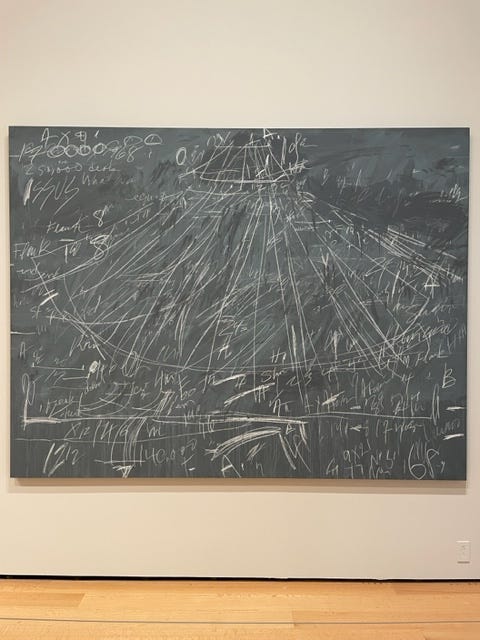
We went to Boston for a date with abstract expressionist Cy Twombly, and we almost came home with early modernist Marc Chagall. It all started with an art review by Sebastian Smee of the Washington Post. One of my favorite art critics, Smee profiled “Cy Twombly: Making Past Present,” the career retrospective on Twombly at the Boston Museum of Fine Arts, and he grabbed my attention when he wrote, “I’ve been waiting half my life for this show. It’s magnificent.” I’d barely finished telling my wife how I wished I could just hop on a plane and fly cross country for an art exhibit before she was online checking ticket prices. Soon our plans for spring break became a walking tour of Boston’s art scene.
Flying overnight to Boston on Monday, we were fortunate to get an early check in at The Seaport Hotel on the Waterfront, a perfect launching point for various jaunts around Beantown. Because the Boston MFA is closed on Tuesday, we had a day to explore, beginning with breakfast at Flour, a bakery and coffee shop that’s become a Boston institution under James Beard Award-winning pastry chef Joanne Chang. It’s easy to access with nine locations, and Flour’s simple, savory breakfast egg sandwich with crispy bacon, warmed us alongside a rich cappuccino, though it was tough to walk away from the morning buns.
Boston is so walkable that on our way back to the hotel, we were hardly surprised to discover the Institute of Contemporary Art across the street. The Institute, housed in a modernist architectural work of art on the water, features a third floor sitting room with exquisite views of the harbor. Inside we lucked upon the Maria Berrio exhibit “Children’s Crusade,” and her work alone was worth the trip. Berrio crafts huge paintings through a collage of carefully torn Japanese paper and watercolor. From across the room, the images almost appear to be photos. Her current exhibit honoring the struggles of migrants, especially women and children, evokes contemplation of spirituality and social justice.

Wandering through Chinatown later, we ended up so close to Boston Commons that we made an obligatory visit to the new sculpture “The Embrace,” unveiled early this year on the weekend of Martin Luther King, Jr. Day. This incredible bronze piece, memorializing the hug between Dr. King and his wife after he accepted the Nobel Peace Prize, definitely raised some eyebrows when it was installed. In pictures, the sculpture of arms embracing can seem odd. But in person, it’s stunning work, a testament to the incredible power of MLK and Coretta Scott King. While crossing the Commons back toward the North End, the afternoon became a fortuitous visit to a cozy yet elegant gallery on the famed Newbury Street.
The Galerie d’Orsay, housed in a classic brownstone, caught our eye with three Marc Chagall lithographs visible from the street. Upon entering the gallery, the stunning street art of Sen 1 drew us in. Hanging next to a Lichtenstein and Warhol, the frenzied graffiti of a gritty urban backdrop splashed with color reflects the rough vibrant life of the people who inhabit its streets. A Chagall series on the circus ran across the opposite wall, subtly complementing the pop art in the room. Billed as a gallery offering art from five centuries, including several Rembrandt etchings, the d’Orsay consumed much of our afternoon. Talking art with consultant Ben Flythe and gallery co-director Kristine Feeks Hammond, was delightful, as their knowledge and enthusiasm kept us lingering and chatting. When discussing two Matisse drawings on the wall, Ben was so intrigued by another exhibit I referenced, he was soon online looking up the Baltimore collection. The d’Orsay was so captivating we could hardly walk away from the Chagalls that caught our eye from the street.
The following day was reserved for Twombly. With more than one hundred galleries, Boston’s Museum of Fine Arts is one of the world’s top museums, and because the MFA has a renowned collection of classical art, it’s a perfect place for the Twombly retrospective. Curated along with the museum’s vast displays of Greek and Roman relics, the exhibit is a fascinating connection of the old and new. Twombly lived many years in Rome, collecting statuary that, as it decayed, seemed to become a new form of art. Twombly explored that connection in his work believing, as Smee notes, “Modern art isn’t dislocated, but something with roots, tradition and continuity.” The curation by Christine Kondoleon, museum chair of ancient Greece and Rome, is a masterful homage to an icon of abstract expressionism. From Twombly’s famous scribbles, reflecting his interest in ancient text he couldn’t read but found artistically beautiful, to his toy-like sculptures and large scale explorations of color and text, the show honors Twombly’s lifelong exploration of abstraction, decay, and deconstruction.
After spending most of our day at the MFA, we meandered toward the North End, again wandering the shops and galleries on Newbury Street. Following a late lunch of burgers and cheese fries at Crazy Good Kitchen, as well as some reading time at two indie bookstores, we happened across DTR Modern Galleries with promises of pop art icons like Basquiat and Warhol. The staff was heading toward wine o’clock, but when I mentioned being a fan of Warhol contemporary Hunt Slonem, the ladies intrigued me with the comment, “We have a Bunnie Wall in back if you’d like to take a look.” Slonem’s bunnies are like Warhol’s Marilyns to pop art fans, and we spent a while wondering which bunny might suit us. Coming out of DTR, we hadn’t taken five steps before the captivating colors on display drew us across the street to The Sitka Gallery. Sitka, a whimsical and gregarious Oxford-trained artist who worked for years as an illustrator for Ralph Lauren, opened his Newbury gallery five years ago and is always available to talk art and more.
Of course, some of the best art in Boston can be found on the plate and everyone who goes to Boston definitely goes to eat. After a memorable dinner of chicken parm and a fresh seafood linguini on our first night at Giacomo’s in the North End, a cash only operation with regular lines down the sidewalk, we ended our second day just off Newbury at Buttermilk and Bourbon. Celebrity chef Jason Santos’ Boston bistro features elevated New Orleans cuisine, and it serves up one of the best whiskey cocktails I’ve ever had with Whistlepig Piggyback Rye and Vermont maple syrup. Our dinner at the bar included short rib croquettes, barbeque shrimp over jalapeno grits, and a dessert of apple biscuit bread pudding with butterscotch, cinnamon creme that I’m still thinking about.
The following morning, on our last day in Boston, thinking we were all art’d out, we headed to the North End for shopping. However, leaving the waterfront, we passed James Hook & Company, a Boston landmark lobster house, and soon we were sitting down for a crab cake and clam chowda breakfast. Later, Boston gave us one more taste of art in the Boston Public Market. Wandering various food stalls, we happened across another delightful artist encounter with the food-inspired pop art of Laurel Greenfield. Greenfield is a charming young woman whose first love was the culinary arts, having gone to BU to study nutrition. When the art world called, she set up shop in Boston’s bustling business incubator, and we couldn’t resist buying a print of her take on Van Gogh’s Sunflowers featuring blooms of bagels, originally commissioned by a local restaurant. It was a perfectly artsy ending to our trip.
Boston is a truly artful destination, and the Museum of Fine Arts is a location we might need to return to soon, having just missed the opening of a show on the famed Hokusai waves. Of course, on our next trip that Chagall print might still be calling to me from the street, and I might not have the discipline to walk away.
Press enter or click to view image in full size
Marc ChagallAdam and Eve and the Forbidden Fruit
From the Bible Suite
1960
Book Edition lithograph
Sheet Size: 14” x 10 ¼”
Friday, February 20, 2026
Journals, Magazines & the drag of exclusive submissions
Thursday, February 19, 2026
Symbolism -- Does It Really Mean That?
The green light, the red hat, the whiteness of a whale ...
Symbolism in literature is the catnip of the English teacher and often the bane of existence and teeth clenching frustration for the high school and college student. "Does it really mean that?" has been asked by more students than "can I have a bathroom pass?" And while the use of symbolism is undoubtedly a key technique for writers of western literature -- drawing heavily from the Judeo-Christian ethic and foundational literary and philosophical works of western civ -- authors and readers will occasionally dismiss the very possibility of a symbolic component, glibly noting "the names were simply pulled from a phonebook" or "sometimes yellow is just a color."
Wednesday, February 18, 2026
About "Meeting Students Where They Are"
I’ve seen the effects of this change up close, having taught English in college classrooms since 2007, and I’ve witnessed the slow erosion of attention firsthand, too: students on computers in the back of lecture halls, then on phones throughout the classroom, then outsourcing their education to artificial intelligence. We know that tech companies supply the means of distraction. But somehow the blame falls on the young reader. Whole novels aren’t possible to teach, we are told, because students won’t (or can’t) read them. So why assign them?
When I walked into my American-literature class at Case Western Reserve University last fall, I looked at 32 college students, mostly science majors, and expected an uphill battle. As my colleague Rose Horowitch has reported, “Many students no longer arrive at college—even at highly selective, elite colleges—prepared to read books.” One-third of the high-school seniors tested in 2024 were found not to have basic reading skills.
Yet by the end of the semester, as we read the last sentence of Toni Morrison’s Song of Solomon, I regretted ever doubting my students. I am now convinced that I was wrong to listen to the ostensible wisdom of the day—and that teachers of literature are wrong to give up assigning the books we loved ourselves. There may be plenty of good reasons to despair over the present. The literature classroom should not be one of them.
Tuesday, February 17, 2026
The survival of public media
Years ago, the talk was about the "war against Sesame Street."
For many years, one of the key cultural battles between Democrats and Republicans was about the federal funding of national public media. And to many people that meant the two organizations at the top which are NPR - National Public Radio - and CFB which manages PBS - The Corporation for Public Broadcasting and Public Broadcasting System. And, of those two, it was PBS that resonated the most with the average voter, consumer, taxpayer because, well, ... "Big Bird and Sesame Street."
That battle over federal funding for public programming that critics and opponents felt slanted to the left and stifled voices from the right was most prominent around 2012 with the candidacy of Mitt Romney, though it hearkens back to the early 90s with the rise of Newt Gingrich and Rush Limbaugh. At the time, there was little enthusiasm for cutting funding to public broadcasting, as it was effectively framed as an attack on Elmo.
Fast forward to the brave new world of 2025, and the Republican Party, controlling the Executive and Legislative branches, has succeeded in cutting billions of dollars that once helped support local public radio and television across the country. Since that legislative battle happened during the passing of the comprehensive spending bill, it seems for now that: Public Media Holds Its Apocalypse at Bay, for Now.
Things looked bleak last summer for KCAW, a tiny public radio station serving the remote community of Sitka, Alaska (population 8,393).
Congress had just slashed $500 million in funding for public media, blowing a $187,500 hole in the station’s budget. Mariana Robertson, the station’s general manager, said she had faced a potential “doomsday” situation that included cutting staff.
Then the donations poured in.
Now, Ms. Robertson is one of many station directors across America who find themselves in unexpected territory: first, expecting the worst, but then buoyed by a flood of emergency funding that has kept their stations stable and surviving. For now.
Monday, February 16, 2026
Vision Quest
Sunday, February 15, 2026
How Ryan Reynolds & Rob Mac Saved Wrexham
It's an unlikely story to say the least, one made in Hollywood with Hollywood stars, to be sure.
A couple of American guys with no real connections to futbol (soccer), Great Britain, or the English Premier League, and all its subsidiaries, decide to buy a soccer team and end up reviving an historic town and franchise at the same time. It's kind of silly, and an even more idealistic narrative than the brilliant and heartwarming story of Ted Lasso that saved the feel good sports story a few years back. This is, of course, the story of "Ryan Reynold, Rob Mac, and Wrexham Football Five Years Later."
“I didn’t know Rob, [Reynolds explains]. But I noticed we followed each other on Instagram. I sent him a little note. I think I even told him not to respond. I just wanted to say I’d enjoyed something he did.”From such inauspicious beginnings came one of the more remarkable sports partnerships. The two actors have spent the past five years transforming the fortunes of not only a football club but an entire town (now city) by restoring a sense of civic pride many locals in Wrexham feared had gone for good.
The Athletic is speaking exclusively to Reynolds and Mac to mark their anniversary today. We are five years on from the February 9, 2021 takeover that has effectively rewritten the book on how to successfully run a football club. And this despite the fact, as Mac quips in our interview, “We still don’t 100 per cent understand the sport!”
To recap, the pair paid a token £1 to buy an ailing team who were then playing down in the fifth tier of the English football pyramid, alongside a promise to invest a further £2million. Five years — and three successive promotions — later, that same club are one promotion from the Premier League and were recently valued at £350million ($475m).
It’s a remarkable rags-to-riches story that has been captured in the Welcome To Wrexham documentary series, whose own successes include 10 Emmys.
Saturday, February 14, 2026
Wuthering Heights is not a love story
Years ago, a group of English colleagues and I took a post-graduate class in literature with another who was a Ph.D. and adjunct for a local university. Several of us were just interested in some professional development while a couple others were using the class as part of their MA in English. The class was primarily Victorian in nature, and we read some incredible works of literature, some familiar - namely Jane Eyre - and others new and obscure - like the sublime melodrama East Lynne from Ellen Wood.
And then we read Wuthering Heights. Surprisingly, none of the English majors in the room had read or taught the book. And for that we were thankful. Truly, the room was in consensus that it was one of the worst novels we can recall reading in its entirety. Other than the professor, who was quite amused by our contempt for the story, no one enjoyed it, and the reason was clear: it is a truly miserable story in a miserable setting about miserable people and a miserable message.
Consensus: WH is not only not a great love story, it's not a love story at all. And that's an important consideration with the recent release of a film version and the New York Times asking: Is Emily Brontë’s ‘Wuthering Heights’ Actually the Greatest Love Story of All Time?
No. No, it is absolutely not.
The Washington Post has a piece as well, taking a markedly different approach by stating "Wuthering Heights" is the "Birth of the Toxic Boyfriend.
And, yes. Yes, it is.
