Saturday, February 21, 2026

An Artful Trip to Boston

I've been thinking about my arts-focused writing recently, and I revisited this piece from a few years ago. After a wonderful trip to Boston for an art exhibit, I put this piece together, which I think reads quite nicely. Despite pitches to numerous publications, I was never able to place it, so I posted it on my Medium page.  Still, it's a pretty nice piece and a great memory, so I thought I'd repost.

We went to Boston for a date with abstract expressionist Cy Twombly, and we almost came home with early modernist Marc Chagall. It all started with an art review by Sebastian Smee of the Washington Post. One of my favorite art critics, Smee profiled “Cy Twombly: Making Past Present,” the career retrospective on Twombly at the Boston Museum of Fine Arts, and he grabbed my attention when he wrote, “I’ve been waiting half my life for this show. It’s magnificent.” I’d barely finished telling my wife how I wished I could just hop on a plane and fly cross country for an art exhibit before she was online checking ticket prices. Soon our plans for spring break became a walking tour of Boston’s art scene.

Flying overnight to Boston on Monday, we were fortunate to get an early check in at The Seaport Hotel on the Waterfront, a perfect launching point for various jaunts around Beantown. Because the Boston MFA is closed on Tuesday, we had a day to explore, beginning with breakfast at Flour, a bakery and coffee shop that’s become a Boston institution under James Beard Award-winning pastry chef Joanne Chang. It’s easy to access with nine locations, and Flour’s simple, savory breakfast egg sandwich with crispy bacon, warmed us alongside a rich cappuccino, though it was tough to walk away from the morning buns.

Boston is so walkable that on our way back to the hotel, we were hardly surprised to discover the Institute of Contemporary Art across the street. The Institute, housed in a modernist architectural work of art on the water, features a third floor sitting room with exquisite views of the harbor. Inside we lucked upon the Maria Berrio exhibit “Children’s Crusade,” and her work alone was worth the trip. Berrio crafts huge paintings through a collage of carefully torn Japanese paper and watercolor. From across the room, the images almost appear to be photos. Her current exhibit honoring the struggles of migrants, especially women and children, evokes contemplation of spirituality and social justice.


Wandering through Chinatown later, we ended up so close to Boston Commons that we made an obligatory visit to the new sculpture “The Embrace,” unveiled early this year on the weekend of Martin Luther King, Jr. Day. This incredible bronze piece, memorializing the hug between Dr. King and his wife after he accepted the Nobel Peace Prize, definitely raised some eyebrows when it was installed. In pictures, the sculpture of arms embracing can seem odd. But in person, it’s stunning work, a testament to the incredible power of MLK and Coretta Scott King. While crossing the Commons back toward the North End, the afternoon became a fortuitous visit to a cozy yet elegant gallery on the famed Newbury Street.

The Galerie d’Orsay, housed in a classic brownstone, caught our eye with three Marc Chagall lithographs visible from the street. Upon entering the gallery, the stunning street art of Sen 1 drew us in. Hanging next to a Lichtenstein and Warhol, the frenzied graffiti of a gritty urban backdrop splashed with color reflects the rough vibrant life of the people who inhabit its streets. A Chagall series on the circus ran across the opposite wall, subtly complementing the pop art in the room. Billed as a gallery offering art from five centuries, including several Rembrandt etchings, the d’Orsay consumed much of our afternoon. Talking art with consultant Ben Flythe and gallery co-director Kristine Feeks Hammond, was delightful, as their knowledge and enthusiasm kept us lingering and chatting. When discussing two Matisse drawings on the wall, Ben was so intrigued by another exhibit I referenced, he was soon online looking up the Baltimore collection. The d’Orsay was so captivating we could hardly walk away from the Chagalls that caught our eye from the street.

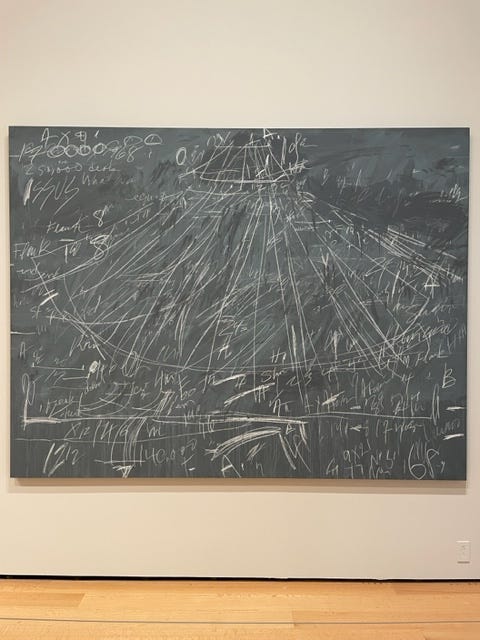
The following day was reserved for Twombly. With more than one hundred galleries, Boston’s Museum of Fine Arts is one of the world’s top museums, and because the MFA has a renowned collection of classical art, it’s a perfect place for the Twombly retrospective. Curated along with the museum’s vast displays of Greek and Roman relics, the exhibit is a fascinating connection of the old and new. Twombly lived many years in Rome, collecting statuary that, as it decayed, seemed to become a new form of art. Twombly explored that connection in his work believing, as Smee notes, “Modern art isn’t dislocated, but something with roots, tradition and continuity.” The curation by Christine Kondoleon, museum chair of ancient Greece and Rome, is a masterful homage to an icon of abstract expressionism. From Twombly’s famous scribbles, reflecting his interest in ancient text he couldn’t read but found artistically beautiful, to his toy-like sculptures and large scale explorations of color and text, the show honors Twombly’s lifelong exploration of abstraction, decay, and deconstruction.


After spending most of our day at the MFA, we meandered toward the North End, again wandering the shops and galleries on Newbury Street. Following a late lunch of burgers and cheese fries at Crazy Good Kitchen, as well as some reading time at two indie bookstores, we happened across DTR Modern Galleries with promises of pop art icons like Basquiat and Warhol. The staff was heading toward wine o’clock, but when I mentioned being a fan of Warhol contemporary Hunt Slonem, the ladies intrigued me with the comment, “We have a Bunnie Wall in back if you’d like to take a look.” Slonem’s bunnies are like Warhol’s Marilyns to pop art fans, and we spent a while wondering which bunny might suit us. Coming out of DTR, we hadn’t taken five steps before the captivating colors on display drew us across the street to The Sitka Gallery. Sitka, a whimsical and gregarious Oxford-trained artist who worked for years as an illustrator for Ralph Lauren, opened his Newbury gallery five years ago and is always available to talk art and more.

Of course, some of the best art in Boston can be found on the plate and everyone who goes to Boston definitely goes to eat. After a memorable dinner of chicken parm and a fresh seafood linguini on our first night at Giacomo’s in the North End, a cash only operation with regular lines down the sidewalk, we ended our second day just off Newbury at Buttermilk and Bourbon. Celebrity chef Jason Santos’ Boston bistro features elevated New Orleans cuisine, and it serves up one of the best whiskey cocktails I’ve ever had with Whistlepig Piggyback Rye and Vermont maple syrup. Our dinner at the bar included short rib croquettes, barbeque shrimp over jalapeno grits, and a dessert of apple biscuit bread pudding with butterscotch, cinnamon creme that I’m still thinking about.

The following morning, on our last day in Boston, thinking we were all art’d out, we headed to the North End for shopping. However, leaving the waterfront, we passed James Hook & Company, a Boston landmark lobster house, and soon we were sitting down for a crab cake and clam chowda breakfast. Later, Boston gave us one more taste of art in the Boston Public Market. Wandering various food stalls, we happened across another delightful artist encounter with the food-inspired pop art of Laurel Greenfield. Greenfield is a charming young woman whose first love was the culinary arts, having gone to BU to study nutrition. When the art world called, she set up shop in Boston’s bustling business incubator, and we couldn’t resist buying a print of her take on Van Gogh’s Sunflowers featuring blooms of bagels, originally commissioned by a local restaurant. It was a perfectly artsy ending to our trip.

Boston is a truly artful destination, and the Museum of Fine Arts is a location we might need to return to soon, having just missed the opening of a show on the famed Hokusai waves. Of course, on our next trip that Chagall print might still be calling to me from the street, and I might not have the discipline to walk away.
Press enter or click to view image in full size
Marc Chagall

Adam and Eve and the Forbidden Fruit

From the Bible Suite

1960

Book Edition lithograph

Sheet Size: 14” x 10 ¼”

Friday, February 20, 2026

Journals, Magazines & the drag of exclusive submissions

It can be a frustrating process for writers and scholars, the path to publishing an article in a journal or magazine. Following the arduous task of actually producing a work of publishable quality -- what did Hemingway say? ... sit down at the writing desk and open a vein -- then comes the job of pitching and querying and waiting for acceptance and rejection.

And, with that is the dreaded request for "exclusive submissions."

While many -- in fact, the majority that I pay attention -- journals and magazines accept simultaneous submissions with the simple request to "please notify us if the piece is accepted elsewhere," some publications put an unrealistic requirement on writers to give exclusive reading rights for several months with no promise of publication. 

While I understand reservations about simultaneous submissions out of concern for the time of submission readers and editors, it's equally challenging for writers and scholars to concede to exclusive submissions and wait for months at a time only to receive a single rejection and start again. Granted, while writers certainly have the freedom to simply not submit to publications with that requirement, I personally feel like it's a flaw in the system.

Thursday, February 19, 2026

Symbolism -- Does It Really Mean That?

The green light, the red hat, the whiteness of a whale ...

Symbolism in literature is the catnip of the English teacher and often the bane of existence and teeth clenching frustration for the high school and college student. "Does it really mean that?" has been asked by more students than "can I have a bathroom pass?" And while the use of symbolism is undoubtedly a key technique for writers of western literature -- drawing heavily from the Judeo-Christian ethic and foundational literary and philosophical works of western civ -- authors and readers will occasionally dismiss the very possibility of a symbolic component, glibly noting "the names were simply pulled from a phonebook" or "sometimes yellow is just a color."


Wednesday, February 18, 2026

About "Meeting Students Where They Are"

It was a simple line in a speech about education, but it packed a wallop:

"... the soft bigotry of low expectations."

That line, written by Michael Gerson and delivered by President George W. Bush in a speech promoting the No Child Left Behind Act, addressed low academic expectations casually, sometimes unconsciously, or worse intentionally, put upon predominantly poor and minority students and directly influencing lower academic achievement. For roughly a quarter century now, ideas about standards and expectations have driven countless reforms in education designed to improve achievement. Much of it has been ineffective.

There are endless bromides and slogans and cliches about best practices and what works for kids, notably the idea that students "rise to the level of expectations." On the other hand, critics might reasonably argue that the idea of "meeting kids where they are," acknowledging individual students' abilities and needs as opposed to more rigid ideas about "how kids are supposed to be" has led to a lowering of expectations. Basically, this might boil down to an assumption and resignation that "kids don't read" and kids won't read an entire novel, or kids can't write a multi-paragraph essay, so schools, classes, teachers simply stopped assigning them.

Clearly that sounds terrible. However, I will not immediately dismiss the idea of being "a responsive educator." By that I mean, approaching each class and lesson with acknowledgement of the actual humans in the classroom, as opposed to simply teaching a curriculum or unit or lesson. Educators must be attentive to the specific knowledge, skills, and needs of the actual students in the classroom or much time can be wasted. That might be from assuming kids simply know something and thus don't need instruction, or even a reminder, which can compromise and almost guarantee glitches in learning if not failure. However, it can also mean assuming kids don't know something, which leads to wasting time with redundancy.

So, it's complicated, to say the least. An interesting and compelling take on the issue, one that has ignited some genuine debate and discussion online and in schools is the advice, even admonition, from Case Western English Professor Walt Hunter in an essay for The Atlantic "Stop Meeting Students Where They Are."

At some point over the past 15 years, kids stopped reading. Or at least their teachers stopped asking them to read the way they once did. We live in the age of the reel, the story, the sample, the clip. The age of the excerpt. And even in old-fashioned literature classes, assignments have been abbreviated so dramatically that high-school English teachers are, according to one recent survey, assigning fewer than three books a year.

I’ve seen the effects of this change up close, having taught English in college classrooms since 2007, and I’ve witnessed the slow erosion of attention firsthand, too: students on computers in the back of lecture halls, then on phones throughout the classroom, then outsourcing their education to artificial intelligence. We know that tech companies supply the means of distraction. But somehow the blame falls on the young reader. Whole novels aren’t possible to teach, we are told, because students won’t (or can’t) read them. So why assign them?

When I walked into my American-literature class at Case Western Reserve University last fall, I looked at 32 college students, mostly science majors, and expected an uphill battle. As my colleague Rose Horowitch has reported, “Many students no longer arrive at college—even at highly selective, elite colleges—prepared to read books.” One-third of the high-school seniors tested in 2024 were found not to have basic reading skills.

Yet by the end of the semester, as we read the last sentence of Toni Morrison’s Song of Solomon, I regretted ever doubting my students. I am now convinced that I was wrong to listen to the ostensible wisdom of the day—and that teachers of literature are wrong to give up assigning the books we loved ourselves. There may be plenty of good reasons to despair over the present. The literature classroom should not be one of them.

Tuesday, February 17, 2026

The survival of public media

Years ago, the talk was about the "war against Sesame Street." 

For many years, one of the key cultural battles between Democrats and Republicans was about the federal funding of national public media. And to many people that meant the two organizations at the top which are NPR - National Public Radio - and CFB which manages PBS - The Corporation for Public Broadcasting and Public Broadcasting System. And, of those two, it was PBS that resonated the most with the average voter, consumer, taxpayer because, well, ... "Big Bird and Sesame Street."

That battle over federal funding for public programming that critics and opponents felt slanted to the left and stifled voices from the right was most prominent around 2012 with the candidacy of Mitt Romney, though it hearkens back to the early 90s with the rise of Newt Gingrich and Rush Limbaugh. At the time, there was little enthusiasm for cutting funding to public broadcasting, as it was effectively framed as an attack on Elmo. 

Fast forward to the brave new world of 2025, and the Republican Party, controlling the Executive and Legislative branches, has succeeded in cutting billions of dollars that once helped support local public radio and television across the country. Since that legislative battle happened during the passing of the comprehensive spending bill, it seems for now that: Public Media Holds Its Apocalypse at Bay, for Now.


Things looked bleak last summer for KCAW, a tiny public radio station serving the remote community of Sitka, Alaska (population 8,393).

Congress had just slashed $500 million in funding for public media, blowing a $187,500 hole in the station’s budget. Mariana Robertson, the station’s general manager, said she had faced a potential “doomsday” situation that included cutting staff.

Then the donations poured in.

Now, Ms. Robertson is one of many station directors across America who find themselves in unexpected territory: first, expecting the worst, but then buoyed by a flood of emergency funding that has kept their stations stable and surviving. For now.

I'm not a regular listener of NPR, and I no longer have broadcast or cable television, so I've mostly noticed the effective in the area I most appreciate the media -- local music radio like The Colorado Sound and Indie 102.3 here in Denver and Fort Collins. And, I am hoping for the continued public support through donations while we hopefully reach a consensus and collaboration on the value of federal funding for public broadcasting.

Monday, February 16, 2026

Vision Quest

It was forty-one years ago, yesterday, that Louden Swain took on "the Shute."

If you know, you know. And Vision Quest is a purely classic teen drama-comedy-inspirational-sports movie from the teen years of Gen X, based on a YA novel from Terry Davis, and starring a young, adorable Mathew Modine alongside Michael Schoeffling (yeah, Jake from Sixteen Candles) and Linda Fiorentino. It's one of the best from one of the best times in cinema -- teen films in the 1980s were a genre above itself, and Vision Quest is a real gem.


Sunday, February 15, 2026

How Ryan Reynolds & Rob Mac Saved Wrexham

It's an unlikely story to say the least, one made in Hollywood with Hollywood stars, to be sure.

A couple of American guys with no real connections to futbol (soccer), Great Britain, or the English Premier League, and all its subsidiaries, decide to buy a soccer team and end up reviving an historic town and franchise at the same time. It's kind of silly, and an even more idealistic narrative than the brilliant and heartwarming story of Ted Lasso that saved the feel good sports story a few years back. This is, of course, the story of "Ryan Reynold, Rob Mac, and Wrexham Football Five Years Later." 

“I didn’t know Rob, [Reynolds explains]. But I noticed we followed each other on Instagram. I sent him a little note. I think I even told him not to respond. I just wanted to say I’d enjoyed something he did.”

From such inauspicious beginnings came one of the more remarkable sports partnerships. The two actors have spent the past five years transforming the fortunes of not only a football club but an entire town (now city) by restoring a sense of civic pride many locals in Wrexham feared had gone for good.

The Athletic is speaking exclusively to Reynolds and Mac to mark their anniversary today. We are five years on from the February 9, 2021 takeover that has effectively rewritten the book on how to successfully run a football club. And this despite the fact, as Mac quips in our interview, “We still don’t 100 per cent understand the sport!”

To recap, the pair paid a token £1 to buy an ailing team who were then playing down in the fifth tier of the English football pyramid, alongside a promise to invest a further £2million. Five years — and three successive promotions — later, that same club are one promotion from the Premier League and were recently valued at £350million ($475m).

It’s a remarkable rags-to-riches story that has been captured in the Welcome To Wrexham documentary series, whose own successes include 10 Emmys.


Saturday, February 14, 2026

Wuthering Heights is not a love story

Years ago, a group of English colleagues and I took a post-graduate class in literature with another who was a Ph.D. and adjunct for a local university. Several of us were just interested in some professional development while a couple others were using the class as part of their MA in English. The class was primarily Victorian in nature, and we read some incredible works of literature, some familiar - namely Jane Eyre - and others new and obscure - like the sublime melodrama East Lynne from Ellen Wood.

And then we read Wuthering Heights. Surprisingly, none of the English majors in the room had read or taught the book. And for that we were thankful. Truly, the room was in consensus that it was one of the worst novels we can recall reading in its entirety. Other than the professor, who was quite amused by our contempt for the story, no one enjoyed it, and the reason was clear: it is a truly miserable story in a miserable setting about miserable people and a miserable message. 

Consensus: WH is not only not a great love story, it's not a love story at all. And that's an important consideration with the recent release of a film version and the New York Times asking: Is Emily Brontë’s ‘Wuthering Heights’ Actually the Greatest Love Story of All Time? 

No. No, it is absolutely not.

The Washington Post has a piece as well, taking a markedly different approach by stating "Wuthering Heights" is the "Birth of the Toxic Boyfriend.

And, yes. Yes, it is.


Friday, February 13, 2026

The Alchemist Project and Our Personal Legends

This is an update and repost of a unit I used around this time of the year when I taught AP English Lang & Comp. One of my favorite times and lessons of the year.

Each year in my AP Language class, as the exam approaches, I shift gears with my highly motivated students, and I ask them to look inside themselves as they look toward their future. It’s a challenging time for young people, and many face anxiety, not over their tests or their grades, but over their identity. As they hurtle forward toward adulthood, they pause. They struggle because, for many, they do not know who they are. These kids are in search of their personal legend. And Paulo Coelho’s classic parable about a shepherd in search of treasure The Alchemist may be just the guidebook they need.

I have a variety of activities designed to help the kids along the way – not the least of which is a series of study questions about the book. They can learn much from the stories of the Englishman, the parable of the oil and the spoon, Santiago’s time with the Crystal Merchant, the idea of “maktub,” the lessons of the camel driver, and more. The story is simple and accessible, and many teachers might worry this book is dumbing things down. But it’s not always about college-level diction and syntax. Sometimes it’s about self-reflection and living deliberately. The kids need this book, and they need to find their “Personal Legend.” Each person has a raison d’etre – a purpose in life – but there is no guarantee we will live the life we were meant to live and fulfill the role we were meant to complete. So, some soul searching is in order.

I couple the study of Coelho’s The Alchemist with a variety of journals and activities designed to get them pondering their place in the universe. For example, I begin with a story from Robert Fulghum’s It Was On Fire When I Lay Down On It about the census. Fulghum’s essay on how every single life matters in serious and significant ways is thoughtful – using a quote from Mary Oliver, I ask the kids, “What do you plan to do with your one wild and precious life?” I give them the classic “Proust Questionaire,” asking them questions about what they are afraid of, what they would never give up, what they would gladly give up, what their perfect day is like, etc. I share with them the story of Sarah Marshall – a misguided teen from Barb Schneider's book The Ambitious Generation. It’s a reminder of the wrong way to approach college and adulthood.

These activities and our discussions of the story culminate in a multi-genre paper called “The Alchemist Project.” For some kids, it’s exactly what they are looking for because they end up finding themselves. Paulo Coelho’s The Alchemist is the perfect “self-help” book for high school students because it comes in the form of a readable parable, and the narrative helps to disguise the preachy nature of many books designed to help teens find themselves and find their way in the world. However, it’s not enough to simply read and discuss the book – teachers need to craft activities and tasks around the ideas of the book which engage the students in their own journey and quest for their personal legend.

Thus, in continuing my explanation of the “Alchemist Project,” I always show a truly engaging TED talk from Mike Rowe of the Discovery Channel’s “Dirty Jobs.” Rowe has some fascinating bits of advice and insight for students. Most importantly, he ponders the idea that “follow your passion” might be the worst advice he ever got. That bit of wisdom fits well with my previous story of Sarah Marshall – the girl from The Ambitious Generation who was adept at getting into college, but not so adept at figuring out why she was going in the first place. I advise my students that in Rowe’s view: “Some people should follow their passion, some should follow their skills, and some should just follow the market.” This video always has a significant impact on students, and I ask them to journal and comment on Rowe’s ideas in relation to their own search.

I also share with students a piece from New York Times writer David Brooks about institutional thinking called “What Life Asks of Us,” followed by perhaps the most interesting and engaging task, which is to complete an extensive analysis of their "Imaginary Lives.” It gives them a chance to dream and wonder, and ultimately try to see themselves in a future. That piece connects students back to a quote from Henry David Thoreau who suggests “if one advances confidently in the direction of his dreams, and endeavors to live the life which he has imagined, he will meet with a success unexpected in common hours.”

All these questions and activities are meant to elicit some serious self-examination, for the goal of this book and this project is for students to figure out, not what they want to do, but who they really are. I ask them to journal again after reading another Robert Fulghum essay about a girl who was “sitting on her ticket,” and I ask them how they are getting in their own way. It always has a way of motivating them to think critically about the choices they make everyday. I always conclude our unit by showing them a short clip of Randy Pausch, the man known for The Last Lecture. Pausch’s book and hour-long presentation filmed at Carnegie Mellon are wonderful, but if you want to limit the time, he gave a compelling short version of his speech on Oprah. It is definitely worth the discussion, and coincides well with the story of The Alchemist. While Coelho’s book says “The universe conspires to help you achieve your personal legend,” Randy Pausch posits, “If you are living correctly, your dreams will come to you.” Ultimately, The Alchemist is a meaningful book for many high school juniors and seniors, and while it’s not academically rigorous, it can be personally enriching. Students sometimes dismiss the book as a little cheesy – and it probably is. But even the most hardened student finds something useful in our “Alchemist Project.”


Thursday, February 12, 2026

Ivies & Top-Tier Schools Waive Tuition

We've all seen it before in movies and television: the "heartbreaking tale" of the bright, talented, and aspirational young adult who rises above their situation and gets into the Ivy League but can't go because the kid is poor, and the college is just way too expensive.

Such an unfortunate situation, ... and also wildly inaccurate, if not completely false and misleading. 

The college admissions process and the price of a degree is not an uncommon point of discussion for American families, and those situations have been an increasing point of concern for decades now. The affordability crisis hits in all sorts of ways, but the affordability of a university education, especially at elite schools like the Ivy League, is an often-misunderstood concept. And, I regularly come across online posts and stories -- and, of course, the annoying Hollywood distortions -- about a kid "getting into their dream school," but turning it down because they can't afford it.

Here's the deal -- a kid growing up in poverty who gains admission to the Ivy League, or elite schools such as the University of Chicago, will likely go to college for free. Elite schools with huge endowments (Yale University's is nearly $50 billion) provide extensive financial aid on a need basis. And, for schools like Penn, tuition is waived completely for families making less than $200,000 annually. 

Starting in the 2025-26 academic year, the University of Pennsylvania (Penn) is offering free tuition to undergraduate students from families with annual incomes up to $200K through its "Quaker Commitment" initiative. For families earning up to $75,000 the aid package also covers housing and dining.

This is part of what Penn calls its "Quaker Commitment." 

While the sticker price for major universities can be eye-popping, it's important to note how few students and families are actually paying full tuition at numbers like $80,000 a year. In fact, at Harvard and many, if not most, of the Ivies, as much 60% of students receive 50% financial aid or greater. Now, that said, half-off of the tuition can still be tens of thousands of dollars a year, and families still face large bills for room and board. But, it's important for families to understand the actual details. And the online Net Price Calculator is quite helpful and pretty accurate in letting students know what they will actually pay. 

Wednesday, February 11, 2026

Pitchers & Catchers Report

Hope springs eternal.

The Boys of Summer are back.

If ya know, ya know. The catchphrase where I grew up -- St. Louis, "the Lou," where baseball is religion -- is always about how many days until "Pitchers and Catchers report."


Tuesday, February 10, 2026

To the favorite teenager in your life

Few poets have the ability to make my smile, laugh, cry, and think all at the same time in the way that Billy Collins does. As a high school English teacher for many years, I realized that I could find a Billy Collins poem for practically every lesson, every discussion, every unit, every situation that I covered in the course of a high school year. Just yesterday I was talking with a colleague about just such a thing, as she began a new unit, and I shared with her one of my favorite Billy Collins poems.

To My Favorite 17-Year-Old High School Girl

Do you realize that if you had started
building the Parthenon on the day you were born,
you would be all done in only one more year?
Of course, you couldn’t have done it alone,
so never mind, you’re fine just as you are.
You’re loved for just being yourself.

But did you know that at your age Judy Garland
was pulling down $150,000 a picture,
Joan of Arc was leading the French army to victory,
and Blaise Pascal had cleaned up his room?
No wait, I mean he had invented the calculator.

Of course, there will be time for all that later in your life,
after you come out of your room
and begin to blossom, or at least pick up all your socks.

For some reason, I keep remembering that Lady Jane Grey
was Queen of England when she was only fifteen,
but then she was beheaded, so never mind her as a role model.

A few centuries later, when he was your age,
Franz Schubert was doing the dishes for his family
but that did not keep him from composing two symphonies,
four operas, and two complete Masses as a youngster.

But of course that was in Austria at the height
of Romantic lyricism, not here in the suburbs of Cleveland.

Frankly, who cares if Annie Oakley was a crack shot at 15
or if Maria Callas debuted as Tosca at 17?

We think you are special just being you,
playing with your food and staring into space.
By the way, I lied about Schubert doing the dishes,
but that doesn’t mean he never helped out around the house.

—Billy Collins

From Aimless Love, Random House, 2013.

"To my favourite 17 year old High-school girl" - Billy Collins -- Video of BC reading


Monday, February 9, 2026

The Muppet Show Returns -- and, man, do we need it.

We'll always have The Muppets.

In a world and nation overly focused on negativity, it's important and practically necessary to remind ourselves that there are many places and reasons to find joy in the everyday. And few "institutions" have the ability and reach to provide simple mirth to so many people in such simple ways as Jim Henson's magical world of friends like Kermit and Miss Piggy and Elmo and the Swedish chef and more.

And, in a time of reboots and remakes and rebrands of classic entertainment from the past fifty years, the return of The Muppet Show is a refreshing and comforting bit of news. I can still recall the Sunday evenings of my youth at 6:00 PM with the purest of sketch comedy, entertainment that wholesomely appealed to the kids who watched and their parents who occasionally check in as well. Thus, February 4 this year hearkened us back to those halcyon days through a collaboration of Disney and ABC to celebrate the 50th anniversary of the show. And as the New York Times reported, This Is Your Grandparents’ ‘Muppet Show,’ Fortunately:

Backstage on the new special, “The Muppet Show,” Sabrina Carpenter excitedly greets Miss Piggy, in whom she recognizes a kindred spirit. “I grew up watching you,” Carpenter says. “My parents grew up watching you. Their parents grew up watching——”
The joke, of course, is that Carpenter ends up offending the diva by implying that she’s old. But there’s a truth to it, too: Since the madcap critters lit the lights on the comedy-variety “Muppet Show” in the 1970s, every generation has gotten its own Muppets.

Sometimes we get them more than once. In 2015, ABC — which had aired the prime-time update “Muppets Tonight” in the 1990s — premiered “The Muppets,” an awkwardly edgy workplace mockumentary. (“This is not your grandmother’s Muppets,” the president of ABC promised/threatened at the time.) In 2020, Disney+ gave us “Muppets Now,” a streaming show about Kermit and company producing mini streaming shows, which lacked the original’s theatrical pizazz.

The premise for “The Muppet Show” of 2026, a (for now) single-episode special premiering on Wednesday on Disney+ and ABC, is comparatively simple: It’s “The Muppet Show.” And wocka wocka wocka, that’s all you need.


Sunday, February 8, 2026

Washington Post Layoffs -- a blow to news, journalism, media

I have to be honest - I was about to cancel my Washington Post digital subscription this month. It wasn't a political protest about the direction of the paper under owner Jeff Bezos. It wasn't about disappointment in coverage of one story or another. It wasn't a fading interest in the daily news. It wasn't the coming increase in the the price of my subscription for renewal. No, it wasn't anything like that. It was simply because I will be moving in a few months, switching jobs and uprooting for a few months. So, it was just a convenience.

But now, I can't. Not now. Not after this.  The shocking announcement that WashPo is "laying off more than 300 journalists," and eliminating sections and features such as all sports coverage and the esteemed books department is a serious blow to journalism. Writing for The Atlantic, Ashley Parker makes no bones about it. This move is pure carnage, and the layoffs amount to what she calls The Murder of The Washington Post:

We’re witnessing a murder.

Jeff Bezos, the billionaire owner of The Washington Post, and Will Lewis, the publisher he appointed at the end of 2023, are embarking on the latest step of their plan to kill everything that makes the paper special. The Post has survived for nearly 150 years, evolving from a hometown family newspaper into an indispensable national institution, and a pillar of the democratic system. But if Bezos and Lewis continue down their present path, it may not survive much longer.

Over recent years, they’ve repeatedly cut the newsroom—killing its Sunday magazine, reducing the staff by several hundred, nearly halving the Metro desk—without acknowledging the poor business decisions that led to this moment or providing a clear vision for the future. This morning, executive editor Matt Murray and HR chief Wayne Connell told the newsroom staff in an early-morning virtual meeting that it was closing the Sports department and Books section, ending its signature podcast, and dramatically gutting the International and Metro departments, in addition to staggering cuts across all teams. Post leadership—which did not even have the courage to address their staff in person—then left everyone to wait for an email letting them know whether or not they had a job. (Lewis, who has already earned a reputation for showing up late to work when he showed up at all, did not join the Zoom.)

The Post may yet rise, but this will be their enduring legacy.

What’s happening to the Post is a public tragedy,

Thursday, February 5, 2026

The Super Bowl Prop Bets

 Long before Draft Kings and FanDuel became omnipresent in the sports universe, offering the "chance" to wager on practically any aspect of any competitive sport, I knew a couple guys at school who introduced me to the idea of "prop bets," specifically on the Super Bowl. They had a side-competition every year during the game with the most random of wagers. They bet on obvious game-related details such as winner, final score, MVP, and individual stats like "how many TD passes will Kurt Warner throw in the game." But then they added in a completely random list of fun propositions.

They bet on the color of the Gatorade poured over the winning coach and which team's cheerleaders would be featured first on a sideline TV shot. They bet on whether a beer commercial or car commercial would come first. They wagered an "over/under" guess on the duration of the National Anthem, and tried to outguess each other on songs during halftime, celebrity appearances, and of course, the coin toss. 

That was my introduction to the idea of the "prop bet," which is now a huge business during the Super Bowl. And I have to admit I love it, even as I have become quite uneasy with the ubiquitous nature of gambling in sports and in contemporary society. Each year, I join a prop bet pool, or host one myself. I've done them individually with forms made on a GoogleDoc, and I've used websites that have a pre-established list as well as a scoreboard that keeps score and ranks all players. The prop bet has become another Super Bowl tradition, like watching the commercials, and the Washington Post recently posted some ideas on their "Favorite Prop Bets for Super Bowl LX." 


Wednesday, February 4, 2026

The Politics of Thoreauvian Punk

Politics is complicated ... and pretty much always has been.

And in my latest project, The Punk on Walden Pond, I am intrigued by the issue of politics in relation to Henry Thoreau and punk rock. Was Thoreau a political writer and theorist? Is punk a political art form? At times Henry Thoreau argued he is not political, and many might say the punk on Walden Pond is above politics. Similarly, while the music and bands of punk rock certainly are anti-establishment and a challenge to the status quo, some musicologists argue that more than 80% of punk songs are not political, and that the bands have no clear political agenda. I'd imagine Joe Strummer, Jello Biafra, and bands like Propagandhi have some thoughts on that.

In my Walden Punk Project, I have a piece-in-progress titled "In the Mosh Pit: the Politics of Thoreauvian Punk." Here are some thoughts from that work.

Chapter 4 of Jane Bennett’s Thoreau's Nature: Ethics Politics & Wild (2002) is titled “Why Thoreau Hates Politics." Thoreau may have hated politics, but that doesn’t mean he wasn’t political. In fact, Bob Pepperman Taylor makes a strong case in two books America’s Bachelor Uncle: Thoreau and the Polity (1996) and Lessons from Walden: Thoreau & the Crisis of American Democracy (2024) for seeing Thoreau primarily as a political writer. He believes that even the supposed “nature writings” such as Walden, "Walking," and "Wild Apples" are actually political positions, specifically in how they criticize and challenge America to be what it claims. And that is as punk as it gets, in my opinion. For, Thoreau is in many ways the first true contemporary critic to challenge the national narrative to call out the American dream to pull back the curtain on the ruse that had been perpetuated against the people.

As far as punk is concerned, it's worth noting that much punk is simply about frustrations with daily life, as opposed to large political manifestos. As Legs McNeil says in his comprehensive history Please Kill Me, “... the great thing about punk was that it had no political agenda. It was about real freedom, personal freedom." In the study Rebel Rock, a review of lyrics suggest only 25% of songs are distinctly political. However, a counterargument is that for the music of a counterculture, even when songs aren’t political, they are. 

In viewing Thoreau as combative and political, and punk as a political movement – even when it’s not trying to be, the key elements are personal conscience and a sense of social justice. The goal of Walden is to promote a kind of personal responsibility because, for Thoreau, the fear is that people will succumb to a less interesting and morally deadening utilitarianism. Thoreau insists that we submit to principles which will make us nonconforming in an unjust world. Thoreau urges readers to be rebellious, be a tradition breaker, be civilly disobedient.


Tuesday, February 3, 2026

Permanent Olympic Sites


In 1972, via a statewide referendum, the people of Colorado rejected funding for the 1976 Olympic Games, becoming the only city ever awarded the games to turn down the chance to host. While that decision shocked the rest of the country, as well as many around the world, it wasn't a surprising move for anyone who knows the taxpayers of the Rocky Mountain state. In fact, knowing what we know now about the structural challenge and fiscal nightmare the Games can be for some cities and countries, it was a surprisingly prescient and prudent move.

Hosting the Olympic Games is an incredible honor and opportunity for a country to shine on the international stage, but it’s also a significant financial and structural investment saddled with huge risks. The Olympics generally cost tens of billions of dollars to stage while providing only a fraction of that in terms of revenue. Host countries must invest heavily in building a vast infrastructure of sites to hold the events, housing for the teams and guests, and transportation and security systems to manage the people. While these can certainly upgrade a city, they are rarely necessary to maintain following the games and often end up in disuse and decay.

Additionally, any benefit from the event is often overshadowed by the corrupt history of the bidding process at the International Olympic Committee and the potential for bloated budgets prior to the event followed by blight afterwards. The scandals plaguing the entire hosting process are extensive, ranging from bribes and extortion to graft and highly orchestrated doping programs which have tainted vast numbers of events and athletes. It often seems the Olympic Games, an international institution intended to honor the individual pursuit of excellence, are more trouble than they’re worth. But it doesn't have to be that way.

Instead, the international community should establish permanent locations for the Olympics, where all countries contribute to maintaining the sites as the premier athletic facilities in the world. The fields and tracks and stadiums could serve as hosts for an endless number of world championships at all levels, and they could also serve as training grounds and research locations to serve all manner of individuals and organizations committed to honoring and promoting the highest levels of athletic achievement.

Choosing permanent locations would obviously be a significant challenge, though certainly not more problematic than the current bidding process. It’s reasonable to have host cities across multiple geographic regions, and it makes sense to consider places which held successful games and maintained some of the original infrastructure. Athens is the obvious choice for one permanent summer location, while Barcelona, Seoul, and Sydney are solid choices as well. Salt Lake City and Lillehammer are good bets for the Winter Olympics, though a strong case can be made for both Vancouver and Turin. Obviously the city and host country must want the honor and responsibility and be willing to trust the rest of the world to support the plan.

This idea is not new, having been discussed for years among commentators, athletic groups, and political leaders. In fact, at the end of the 1896 Games, which launched the modern era, King George of Greece called for Athens to be the permanent “peaceful meeting place of all nations,” and many delegations signed a letter endorsing the idea. Currently, host cities are already established through 2028 when Los Angeles will host its third Olympic Games. And perhaps that’s enough. Before any more bidding happens and planning begins, the public should discuss the idea of permanent host cities. Once the idea is floated to athletes and voters, political and business leaders should take the discussion to the IOC and make it happen. With many future games already assigned and planned, there is plenty of time to develop and implement this logical change to the Games.


Monday, February 2, 2026

Groundhog Day - a time for reflection and renewal

Groundhog Day was once about the annual folk tradition of looking to a small animal for predictions about the weather. But since 1993, the day - or at least the phrase - has become part of the lexicon, describing the boring, monotonous nature of everyday life. The Harold Ramis film that established that idea is actually about the opposite. Here's an essay I wrote a few years ago: 

It’s not about monotony — it’s about re-birth.

Twenty-six years ago, an unassuming little film about a cantankerous weatherman on the most random of holidays became a pop culture phenomenon that ingrained itself in our consciousness. The title became a metaphor for reluctantly acknowledging the dailiness of life. With the silly story of Phil Connors waking up everyday in Punxsutawney, PA, with Sonny and Cher singing “I’ve Got You Babe” on an endless string of February seconds, Groundhog Day entered the lexicon as a way to describe the drudgery and repetition of daily life. But the movie was never simply about the mundane nature of existence. It was always about self-awareness and second chances and reinvention and hope.

Let’s face it, by February 2 the New Year’s resolutions are fading, the fitness centers are back to the regulars, and we’re all bogged down in the drudgery of winter. These moments are ripe for a bit of pop culture existentialism, and the quirky film from Harold Ramis and Danny Rubin puts that long cold winter, the odd little holiday, and the repetitiveness of daily life in perspective. Watching the story of a disgruntled weatherman pondering the absurdity of a weather-forecasting rodent provides a second chance at mid-winter self-reflection and re-invention. The conceit of the film is not only the ridiculous holiday but also the inexplicable weirdness of Phil Connors’ predicament.

The film Groundhog Day is actually a wonderful primer for the wisdom of existentialism, and when I taught the philosophy in my college literature class, I would often lead or conclude with a viewing of Bill Murray’s brilliant portrayal of a man trying to bring some sense of meaning to a life that seems nothing short of absurd. Clearly, the idea of living the same day over and over again in an unfulfilling, dull, mundane place and repeating the seemingly mindless tasks of a pointless job is portrayed as a curse and a cruel joke, and that realization is at the heart of existentialism. Life makes no sense. Phil spends many years in disgruntled fashion viewing his life as exactly that, a cruel meaningless joke of an existence.

Read the rest of the essay here ...

Sunday, February 1, 2026

It's the Housing, Stupid

It all comes down to housing, doesn't it?

I am so glad that I moved to Greenwood, Village, CO, when I did in 2003, and that I also sold my house and moved out in 2024. GV is one of the toniest suburbs of Denver, with an average home price of well over $1million. And, that's completely out of range for working middle class people like teachers and police officers. Fortunately, at one time, the area allowed a fair number of townhouses and duplexes, which is where I was able to buy, directly adjacent from the high school. But those days are over, as several years ago, the millionaires were freaked about the possibility of multi-family housing coming to their little hamlet, and a (hysterical) group called "Save Our Village" got on city council, where they effectively outlawed the construction of anything less than single-family homes on quarter-acre lots.

I've been thinking about that recently after reading an interesting substack essay called "The Housing Theory of Everything" and a recent column from Nicholas Kristoff in the NY Times about how to save the American Dream through programs like Hope VI

We need some good news now, and here’s some out of left field: An important new study suggests that there’s a highly effective way to overcome one of the most intractable problems in 21st-century America — intergenerational poverty. We like to think of ourselves as a land of opportunity, but researchers find that today the American dream of upward mobility is actually more alive in other advanced countries.

The new study highlights a powerful way to boost opportunity. It doesn’t involve handing out money, and it appears to pretty much pay for itself. It works by harnessing the greatest influence there is on kids — other kids. The study, just released, is the latest landmark finding from Raj Chetty, a Harvard economist, and his Opportunity Insights group, along with other scholars.

The team dug into the long-term effects of a huge neighborhood revitalization program called Hope VI. Beginning in 1993, Hope VI invested $17 billion to replace 262 high-poverty public housing projects around America.